
There are moments in life when everything around us feels uncertain. You look at the world, hear the news, or even just observe people around you, and something feels off. There is unrest, confusion, and a quiet fear that sits in the background of everyday life. Many things are happening that we cannot control, and that reality can feel overwhelming at times. But what if the real issue is not just what is happening around us, but what is happening within us?
The Bible gives us a powerful story through the life of Nehemiah. When he heard that the walls of Jerusalem were broken down and burned, it didn’t just concern him—it broke him. He didn’t move on with his life or ignore it, but he wept, mourned, and prayed. The condition of the city became a burden on his heart. Have you ever felt something like that? A moment where something you hear or see doesn’t leave you, where it stays with you and begins to stir something deeper inside?
Nehemiah was in a comfortable place in life. He had stability, position, and security. But when he heard about the broken walls, he couldn’t stay where he was. The burden pushed him to act. When the king noticed his sadness and asked him what was wrong, Nehemiah didn’t hide it. He opened his heart and spoke honestly. That’s something we often struggle with—we carry burdens, but we don’t always bring them out, even before God.
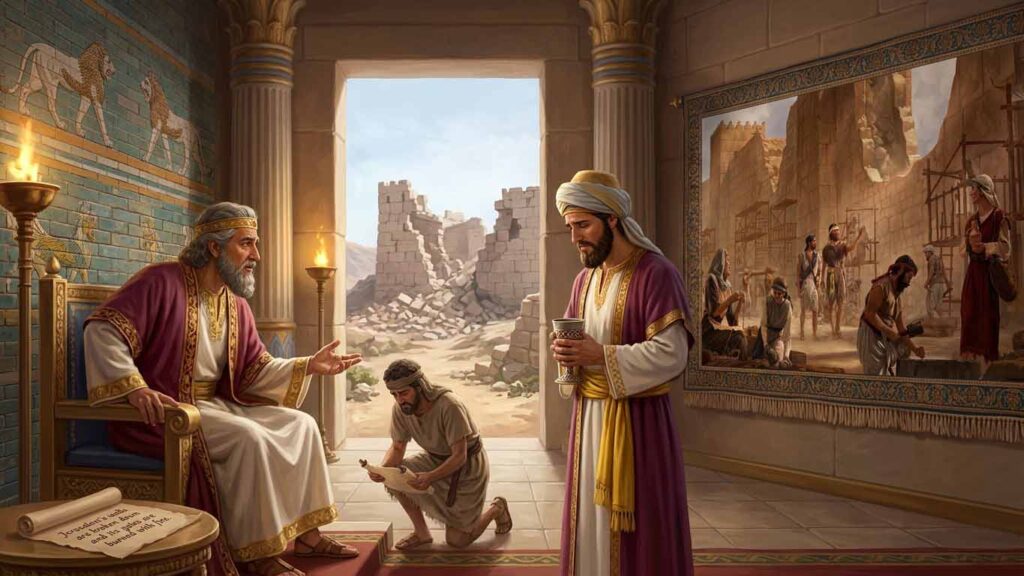
A representation image of Nehemiah standing in front of the king, who noticed Nehemiah’s sadness and asked about his concern.
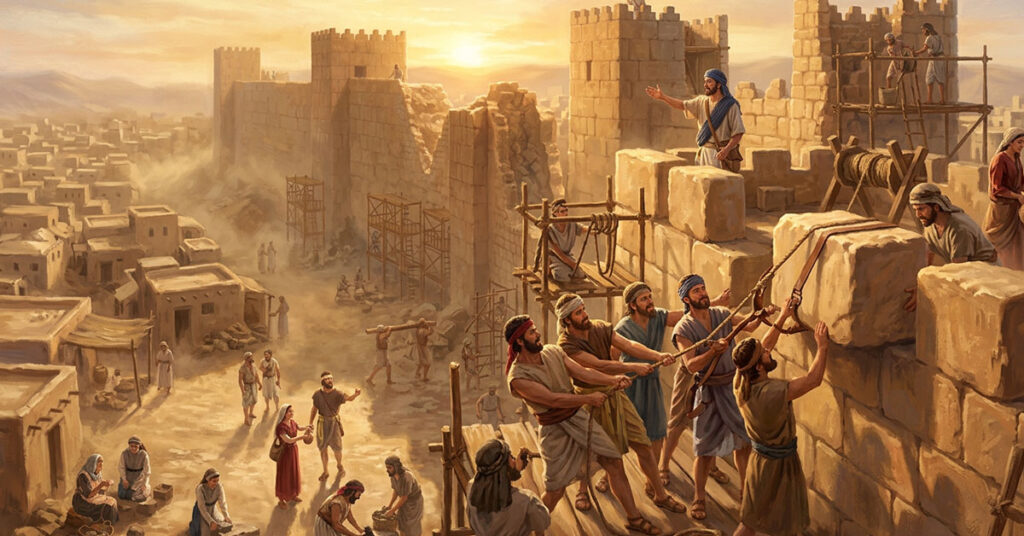
When Nehemiah finally reached Jerusalem, he didn’t rush into action immediately. He took time to quietly observe the broken walls for himself. He saw the damage, the destruction, and the reality of what needed to be done. Only then did he call the people together. He didn’t say, “I will fix this alone.” Instead, he said, “Let us build.” That one moment changes everything, because broken things are rarely restored alone. They are rebuilt together.
At first, not everyone responded positively. Some people hesitated, made excuses. They didn’t believe anything could change. That reaction is very real because even today, when something is broken, whether in our lives or around us, the easiest response is to step back and do nothing. But slowly, something shifted. The people came together, and each person took responsibility for a part of the wall. No one built everything, but everyone built something. And that is how the wall began to rise again.
This story is not just about a city in the past. It reflects something happening in our lives today. Many times, the walls that are broken are not physical walls, but the unseen ones within us. They don’t collapse suddenly; they break slowly, through pride, through a lack of humility, through anger, through disobedience, and through the way we treat one another.
We hear so many stories and life experiences around us every day. I remember one incident from my college days that has stayed with me. I won’t mention names, but this was someone I knew closely. He was my senior, and in the beginning, he seemed like a good person. I used to spend time with him, visit his home, and even got to know his family. But as time went on, I noticed changes in him. He became insecure and unpredictable. He started avoiding me, especially because I would often correct him or advise him when I saw something wasn’t right. Even though I was younger, he had a certain respect, and maybe even a kind of fear—toward me because of that.
At first, I didn’t think much of his distance. I assumed he was just busy with life. But years later, I heard something that completely shocked me. I came to know that he had married his own brother’s wife. That alone was difficult to process, but what made it even more disturbing was what led up to it. I later heard that he had planned a situation that caused his brother to be involved in a serious street incident, which resulted in loss of life and led to his brother being imprisoned. During that time, he got close to his brother’s wife and eventually married her, and they even had a child.
That incident stayed with me deeply. I couldn’t forget it. When he later tried to reconnect with me, I chose to distance myself. Not out of hatred, but because I couldn’t accept what had happened.
Situations like this exist in the world we live in. They may not always be this extreme, but brokenness shows up in different ways. And if we are honest, maybe we’ve seen traces of it even in our own lives. There are moments when patience runs out, when love becomes difficult, and when unity feels distant. And slowly, without even realizing it, something inside us begins to collapse. God sees that. But He doesn’t look at it to condemn us. He looks at it with a desire to restore. Just like Nehemiah felt the burden to rebuild, God is calling us to rebuild what has been broken within us.
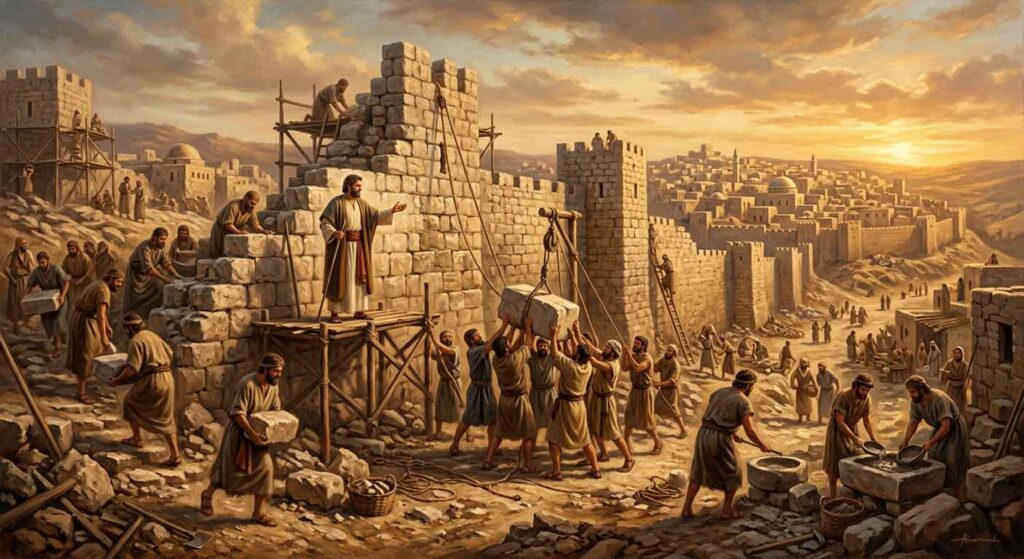
A representation of Nehemiah overseeing the rebuilding of the temple, as everyone came together to restore it to its former glory.
Rebuilding, however, is not easy. It requires honesty, requires letting go of things we’ve held onto for too long. It requires facing parts of ourselves we often avoid. And many times, we resist that process because it is uncomfortable. It is easier to leave things as they are. But the truth is, broken walls leave everything exposed. They don’t protect anything. They only weaken what is inside.
Nehemiah also faced opposition. There were people who did not want the wall to be rebuilt. They discouraged him, mocked him, and tried to stop the work. And in our lives, that same kind of opposition still exists. Sometimes it comes from others, but many times it comes from within us. Doubts, fears, and old habits begin to speak louder the moment we try to change. I’ve experienced this personally. There are times when I try to overcome certain habits or patterns, but it becomes so difficult that I realize I cannot do it on my own. There are moments when the struggle feels too strong, and unless we seek help—whether through support from others or through divine strength—we find ourselves falling back into the same place again.
But even in those moments, the work of rebuilding cannot stop. It must continue, even when it feels hard, even when the voices within us try to pull us back.
There is a simple picture that helps us understand this. A single stick can be broken easily, but when many sticks are tied together, they become strong. That is the power of unity. That is what Nehemiah brought to the people. And that is what God is still calling us to today.
God is inviting us to rebuild the broken walls in our lives. Not perfectly, not all at once, but step by step. Each of us has a part to play. Maybe it is learning to be more patient, or maybe it is choosing forgiveness, or maybe it is letting go of pride or restoring a relationship. Whatever it is, the rebuilding begins when we respond. You don’t have to fix everything overnight. Start with what God is showing you right now. When each person does their part, something beautiful begins to take shape. And over time, what was once broken can stand strong again.
In the end, this is not just about rebuilding something outward. It is about what God is restoring within us. Because when He rebuilds our hearts, everything else begins to align. And when Christ returns, it will not just be about what we achieved, but about what was transformed inside us.
So the question is simple. Will we leave things broken, or will we respond to the call and begin to rebuild?
This story is a thread in Barely holding on
“But they that wait upon the LORD shall renew their strength; they shall mount up with wings as eagles.”
Isaiah 40:31 · KJV
Still feeling this? Follow the thread