

Screen addiction, also known as technology addiction or digital addiction, refers to excessive and compulsive use of smartphones, tablets, computers, and televisions. It is a growing concern in today’s digital age, where screens have become an integral part of our daily lives.

Representation of a child struggling with screen addiction
You might be sitting at the edge of your bed, a blue light illuminating your face in the dark. It might be the tenth time you have checked your phone in five minutes, or maybe even more. You could be waiting for an urgent email, a reply from someone you care about, your exam results, or a life-changing call.
You would have already checked your social media updates, watched the latest news and videos that filled your feed, switched between Instagram and Facebook multiple times, and still find yourself asking, “Why am I still glued to my phone?”
Instead of spending time building real-life relationships, we slowly fill that gap by scrolling through people’s lives online and distracting ourselves with unnecessary entertainment. We even justify our situation by telling others that we are too busy to meet or spend time together. But deep down, we know the truth. We know exactly what we are doing, and sometimes, when we think about it honestly, it almost feels laughable.
“We are more connected than ever, yet more alone than ever before.”
I had this problem in my teenage years. That was the time when Facebook and Instagram were just developing. I still remember Orkut. Does anyone remember Orkut? Did you use it? It came before Facebook. I was actually hesitant to use Facebook when it launched, but slowly I got into it. Before I realized it, I was spending hours watching videos, scrolling through posts and images, chatting with random people, and wasting time without any concern for my studies or responsibilities.
If it was that strong even 15 years ago, imagine how much stronger it is now. Look at the world today, especially among Gen Z and the younger generation. Social media content has exploded. People spend most of their time watching reels, stories, and posts, but they don’t have real connections with the people around them. This is an addiction. And what is worse is that even this addiction slowly pulls even our loved ones in without them realizing it.
“The more we scroll, the less we truly connect.”
Today, I see kids as young as three or five years old using phones, scrolling endlessly through social media without any filters. I have seen this even in my own family. I used to get upset with parents for allowing children to use phones so early. We came back home, and instead of changing or resting, a small boy, just five years old, came and asked, “Where is the phone?” He said he couldn’t do anything unless he watched reels first. And the mother, with a smile, gave him the phone just to keep him calm.
Look at what is happening here. At such a young age, the level of dependency is already so strong. Imagine how that mind will grow in the coming years. What concerns me even more is the kind of content they watch. These kids play videos loudly without understanding what is appropriate and what is not. I have seen moments where explicit content appears, and while it feels uncomfortable even for adults, children just watch, smile, and scroll away. They don’t even understand what they are seeing. Privacy and boundaries no longer exist in their understanding.
I remember another experience from my childhood in India. We used to play cricket on the streets, and there was a boy around ten years old. Do you know what he was known for? Everyone knew him for supplying explicit videos to others. At that age, he knew how to download and share such content. He knew actors, categories, everything. Imagine that. That world completely consumes a ten-year-old.
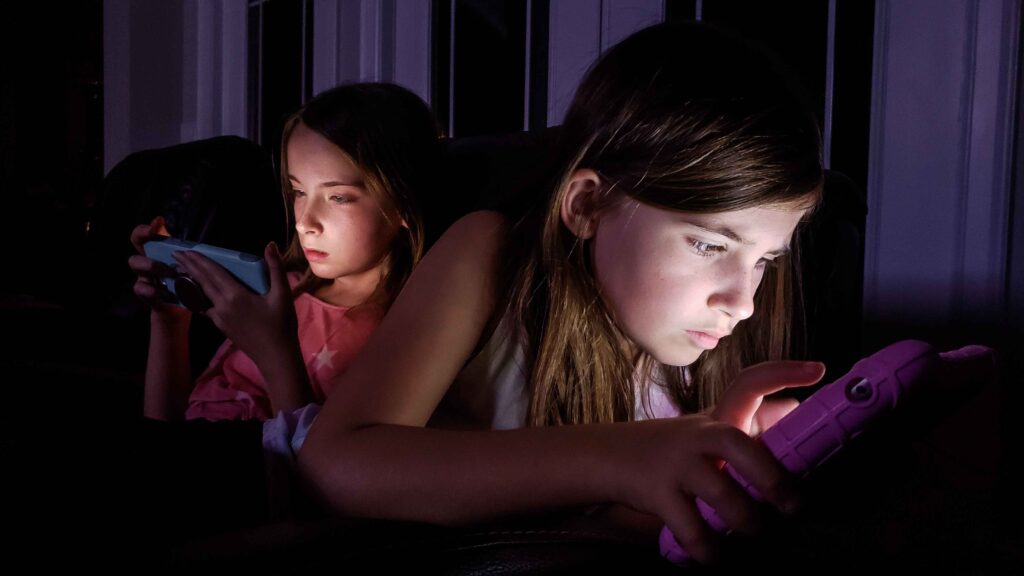
Addicted to screens early in life grows into a serious habit hard to break.
The level of distraction today has reached an extreme stage. It is a serious issue. Even parents, unknowingly, push children into this trap. When kids cry, we give them screens to calm them. But today’s children are smart.
They learn to manipulate situations. And many parents, instead of correcting them, simply give in, saying, “What can I do?” But the Bible teaches us to correct and guide a child. Discipline is not cruelty; it is protection. Ignoring correction only leads them further into harmful patterns.
Now look at the content we consume today—music, movies, videos. Are there any real guardrails? Almost every form of entertainment today carries some form of distraction or inappropriate content. Yes, there are good contents, Christian messages, uplifting songs—but let’s be honest. What do we naturally choose? Entertainment or truth? Many times, when a Bible verse appears on our screen, we read it quickly and scroll past it. But when entertainment comes, we stay. Our minds are trained that way now.
We crave constant stimulation, whether good or bad. Another trap today is how content is designed. You don’t get the full thing; you get a small portion, just enough to hook you. Then you are encouraged to pay, subscribe, or continue watching. This cycle pulls people deeper and deeper into addiction. Social media is now a massive business built around keeping people engaged and dependent.
Studies have even shown that increased negative interactions on social media lead to higher levels of loneliness and depression. Loneliness triggers poor mental health, and poor mental health pushes people deeper into isolation. We carry our devices everywhere and feel uncomfortable without them. We avoid real conversations and replace them with screens.
So the real question is, what is the solution?
Loneliness is not just about being alone. It is a sign that something deeper is missing. It reflects a disconnection from how we were created to live and, ultimately, a disconnection from God.
We were created for connection—with God and with others. We are not designed to live in isolation, yet many of us slowly drift into it without realizing. The more we disconnect from real relationships, the more we feel empty inside. We are living in a stage where evil forces are pulling us tighter into loneliness. You may have heard the saying, “Loneliness is Satan’s playground.”
But the real question is this—are you truly lonely, or are you making yourself lonely? Think about that. Your addictions today do not decide your destination. We cannot take it for granted and say, “I will come back to God later, after I finish this.” That “later” may never come. We sit comfortably in our situation and still complain to God, asking, “Do You care about me? Why don’t You come and save me?” But we don’t realize that we are actually comfortable where we are. On the surface, we may say, “I want to change,” but deep inside, we are enjoying the comfort that sin has given us.
This loneliness epidemic can change if each of us chooses to step out of the traps we are in. We already know what is wrong. We know what is pulling us down. God has created us with awareness. Deep inside, we know when something is not right. That is the signal to change. We need to train our minds to listen to that gentle voice of the Holy Spirit. He is always speaking, always calling us back into a deeper relationship with God. You don’t have to live with fear of missing out. God will never forget you. He will never leave you behind. His love for you is just as real and just as strong as His love for anyone else.
“No screen can fill a space that was created for God.”
My friend, whether you are young or old, whether you feel trapped or lost, remember this—God has never taken His eyes off you. He has never skipped you. He truly cares for you and is waiting for you. And the closer you come to Him, the more clearly you will begin to see the plan He has for your life. So will you take that step today? Will you choose to fight? Choice is yours.
This story is a thread in Lonely
“I will never leave thee, nor forsake thee.”
Hebrews 13:5 · KJV