Sabbath School
Authentic Christian Ministry
Quarter 3, 2026
This week's lesson explores what authentic Christian ministry looks like through Paul's second letter to the Corinthians. It traces how genuine ministry is marked not by self-promotion but by transformed lives, willingness to suffer, Christ-centered motivation, and a call to holy, reconciled community. The lesson ends with Paul's overflowing joy when the Corinthians responded to his love with repentance and open hearts.
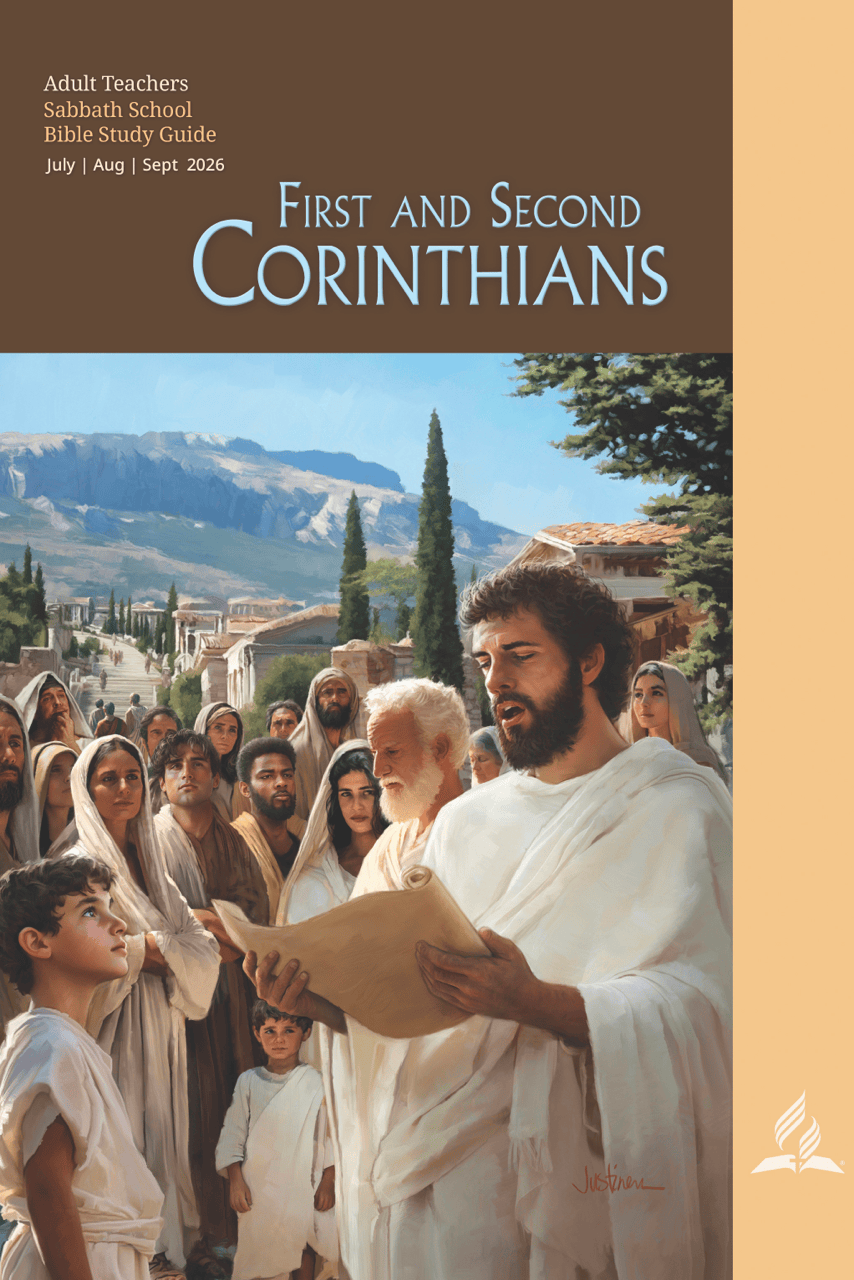
Authentic ministry is not about impressive credentials or personal charisma — it is about carrying the life and death of Jesus in ordinary, fragile human vessels so that others are reconciled to God.
Whoever you are
Whether you follow Christ or are simply curious about what genuine religious life looks like, Paul's letter cuts straight to the heart of a universal question: what makes a person's influence truly trustworthy? This lesson argues it is not status, talent, or polish, but integrity under pressure, love that costs something, and the willingness to be honest about one's own weakness. Those are qualities every human community — religious or not — recognises and needs.
The week, day by day
Paul's extended reflection on ministry in 2 Corinthians 2–7 sets up a searching question for us all: what does it actually look like to serve Christ with sincerity, not performance?
The best letter of recommendation any minister can carry is not a document but a person — someone whose life has been genuinely changed by the gospel. The Corinthian believers themselves were Paul's living credential.
Paul's famous 'not crushed… not in despair… not destroyed' language reveals a stunning paradox: weakness and suffering do not disqualify a minister — they become the very window through which Christ's resurrection life becomes visible to others.
Because Paul knew he would one day give an account to Christ, his ministry was driven not by fear of critics or hunger for applause but by reverent love — he boasted only in the cross, never in himself.
Holiness is not cold separation from people; it is warm, affectionate life within the community of faith, free from the corrupting influences that would erode love and integrity — reconciliation with God expressed in reconciliation with one another.
When the Corinthians opened their hearts in repentance, Paul's response was an almost uncontainable burst of joy — a reminder that pastoral ministry at its best is a relationship of mutual love, not a one-way transaction.
The whole universe is watching: every act of genuine repentance and reconciliation is evidence that God's forgiveness is real, and that fragile, flawed human communities can be transformed by grace.
In depth
Paul's second letter to the Corinthians is one of the most personally revealing documents in all of Scripture. In it, we don't get a polished theological treatise — we get a pastor's beating heart. This week's lesson invites us to look closely at what authentic Christian ministry actually looks like, and the picture Paul paints is at once humbling and deeply encouraging.
We begin with a striking image in 2 Corinthians 3. In the ancient Greco-Roman world, traveling teachers and philosophers carried letters of recommendation — essentially professional references from respected figures. Paul arrives without any such paperwork. His credentials, he says, are the changed lives of the Corinthian believers themselves. They are his 'epistle,' written not with ink but by the Spirit of the living God. This is a profound reorientation of what 'proof' of ministry looks like. The fruit of transformation in human lives is the only résumé that ultimately matters. Paul is careful, though, to resist any pride in this: he is quick to say that his sufficiency comes from God, not from himself. He is a minister of a new covenant — not because the old covenant was without grace (salvation has always flowed from God's faithfulness, from Abel to Abraham to Isaiah), but because the new covenant, inaugurated in Christ, makes the Spirit's inward, life-changing work fully visible and available to all people everywhere.
Monday's reading plunges us into one of the most poignant passages Paul ever wrote. He describes himself as a clay pot — a cheap, fragile, everyday vessel — carrying an incomprehensible treasure. The treasure is the light of the knowledge of God's glory in the face of Jesus Christ. The ordinariness of the container is the whole point: when something extraordinary happens through something ordinary, nobody can mistake the source of the power. Paul's list of sufferings is not a complaint — it is a testimony. Pressed but not crushed, perplexed but not despairing, struck down but not destroyed. There is a resilience here that defies human explanation, and Paul knows it. He is 'always carrying in the body the death of Jesus, so that the life of Jesus may also be manifested.' In other words, his weakness becomes the very theater in which Christ's strength is displayed. This is not masochism or passivity — it is a profound theological conviction that the cross-shaped pattern of death and resurrection is woven into the fabric of authentic ministry. The reformer John Huss, facing his own death with similar peace, understood this instinctively: if the Master suffered, why should the servant expect to be exempt?
Tuesday and Wednesday turn to the motivations and the ethics of ministry. Paul's ministry is not self-promotional — it is Christ-saturated. He does not boast in his own accomplishments but in the cross (). His fear of the Lord is not a cowering terror but the reverent awe of someone who has looked into the face of holy love and been undone by it. This is what drives him to persuade people — not manipulation, not flattery, but a deep, almost desperate desire that others experience what he has experienced. And then comes the call to holiness in 2 Corinthians 6 and 7: Paul urges the Corinthians to open their hearts wide to God and to each other, to separate themselves not from the world's people but from the world's corrupting values and entanglements. Holiness here is not cold withdrawal — it is warm, relational, and communal. The evidence of genuine reconciliation with God, Paul argues, is the pursuit of reconciliation with each other.
The lesson closes with one of the most tender scenes in the New Testament. Paul, who had written a painful, severe letter to the Corinthians (now lost to us, but referenced in chapter 7), was in genuine anguish waiting to hear their response. When his co-worker Titus finally arrives with the good news that they had received the letter with repentance and renewed love, Paul practically overflows. 'I am filled with comfort. I am exceedingly joyful in all our tribulation.' This is the comfort and joy that authentic ministry produces — not the shallow satisfaction of having been right, but the deep gladness of a community restored, hearts reopened, relationships healed. It is a foretaste of the reconciliation that is the whole point of the gospel itself.
The Cracked Pot That Watered the Garden
Paul's image of himself as a clay jar carrying treasure is not so different from this ancient parable. He knew he was cracked — battered by beatings, worn by sleeplessness, hollowed out by anxiety for the churches. But in every crack, the light of Christ leaked through in ways a polished, self-sufficient vessel never could. The Corinthians themselves, and countless others who watched Paul endure suffering without being destroyed, saw something they could not explain by merely human categories. They saw resurrection power in a mortal body.
This is what the lesson this week calls us to embrace: authentic ministry is not the ministry of impressive people projecting strength. It is the ministry of honest, fragile, willing people who have stopped pretending to be sufficient in themselves and have discovered that God's grace is most visible precisely where human self-reliance ends. The crack in the pot is not something to hide — it is where the treasure shines through.
Other voices
Ellen White draws on the example of John Huss to show that the willingness to suffer is not a sign of weakness but of solidarity with a suffering Savior — a theme that sits at the very heart of Paul's 'clay jar' theology in 2 Corinthians 4.
Ellen White describes the reconciliation at the center of the gospel as something that ripples outward — first God and humanity are reconciled through Christ, and then that reconciliation becomes visible in how believers relate to each other and to the watching universe. This cosmic dimension deepens Paul's ministry-of-reconciliation theme in 2 Corinthians 5.
Knight notes that Paul's entire apologetic in 2 Corinthians is shaped by a 'theology of the cross' — a consistent pattern in which apparent defeat becomes the vehicle for divine power. This helps explain why Paul does not defend himself by listing successes but by cataloguing his sufferings: in his theological world, the two are not opposites but partners.
Take it with you
Let your life — not your words alone — be the evidence of your faith; ask yourself whose life is different because of your faithful presence.
When hardship comes in your ministry or daily work, resist the temptation to see it as failure; suffering endured with integrity can reveal Christ more powerfully than comfort ever could.
Cultivate openness and warmth within your church or community — reconciliation with God always flows outward into reconciled, affectionate relationships with the people around us.
What is Sabbath School?
Sabbath School is part of Adventist worship, held before the main service each Saturday. Its purpose is simple: to read the Bible together and understand it better.
Each week has a topic, and the same lesson is studied worldwide. What makes it distinctive is how it is discussed — deliberately in small groups rather than one large gathering, so everyone present can take part. People share what they noticed, ask the questions they are actually carrying, and work through the passage together. Nobody is only listening.
The aim is not to arrive at a single answer but to send everyone away knowing the Bible a little better than they did that morning. You do not need to be Adventist to follow along, and you do not need to have read anything beforehand.
This overview was made to make the week’s Sabbath School reading clearer. It is based on the official Adult Bible Study Guide published by the General Conference of Seventh-day Adventists, and is meant to be read alongside the lesson, not in place of it.
The overview, its structure and its commentary were developed for the Christo Samuel Sabbath School app and this site. They are not to be copied, reproduced or republished elsewhere. If you spot an error, please let me know — I am always glad to correct it.
Lesson content © General Conference of Seventh-day Adventists · Adult Bible Study Guide. Overview and commentary © 2026 Christo Samuel.
The daily readings
The lesson itself, day by day, as published in the Adult Bible Study Guide. Tap any reference to read the passage.
Sab 29 Aug Authentic Christian Ministry
Read for This Week’s Study , , , , , :1, 2 Corinthians 7.
Memory Text: “We are afflicted in every way, but not crushed; perplexed, but not driven to despair; persecuted, but not forsaken; struck down, but not destroyed; always carrying in the body the death of Jesus, so that the life of Jesus may also be manifested in our bodies” (, ESV).
Last week, we saw that Paul, by affirming his simplicity and sincerity, defended himself from the accusations of inconstancy and lack of love toward the Corinthians. He always worked for the best interests of his spiritual children. He began a line of thought in that goes to 2 Corinthians 7. While doing so, he reflects on what an authentic ministry for Christ looks like. We can draw so many lessons from Paul’s thoughts in that regard.
This week, we will look into 2 Corinthians 3–7, where Paul speaks of his ministry of gaining souls for Christ. Ellen G. White says, “The conversion of sinners and their sanctification through the truth is the strongest proof a minister can have that God has called him to the ministry. The evidence of his apostleship is written upon the hearts of those converted, and is witnessed to by their renewed lives. Christ is formed within, the hope of glory. A minister is greatly strengthened by these seals of his ministry.”—The Acts of the Apostles, p. 328.
*Study this week’s lesson to prepare for Sabbath, September 5.
---
Selected Quotes from Ellen G. White
Ministry means service, and to this ministry we are all called. It is a dishonor to God for anyone to choose a life of self-pleasing. My brethren and sisters, do you realize that every year thousands and thousands of souls are perishing, dying in their sins because the light of truth has not been flashed upon their pathway? . . . There is a great work to be done in our world. Men and women are to be converted, not by the gift of tongues nor by the working of miracles, but by the preaching of Christ crucified. Why delay the effort to make the world better? Why wait for some wonderful thing to be done, some costly apparatus to be provided? However humble your sphere, however lowly your work, if you labor in harmony with the teachings of the Saviour, He will reveal Himself through you, and your influence will draw souls to Him. He will honor the meek and lowly ones, who seek earnestly to do service for Him. Into all that we do, whether our work be in the shop, on the farm, or in the office, we are to bring the endeavor to save souls. We are to sow beside all waters, keeping our souls in the love of God, working while it is day, using the means entrusted to us in the Master’s service. Whatever our hands find to do, we are to do it with cheerfulness; whatever sacrifice we are called upon to make, we are to make it cheerfully. As we sow beside all waters, we shall realize the truth of the words, “He which soweth bountifully shall reap also bountifully.” We owe everything to grace, sovereign grace. Grace ordained our redemption, our regeneration, and our adoption to heirship with Jesus Christ. Let this grace be revealed to others. The Saviour takes those whom He finds will be molded, and uses them for His own name’s glory. He uses material that others would pass by, and works in all who will give themselves to Him. He delights to take apparently hopeless material, those whom Satan has debased, and through whom he has worked, and make them the subjects of His grace. He rejoices to deliver them from suffering, and from the wrath that is to fall upon the disobedient. He makes His children His agents in the accomplishment of this work, and in its success, even in this life, they find a precious reward. But what is this compared with the joy that will be theirs in the great day of final revealing?—Reflecting Christ, p. 256.
Sun 30 Aug Fruits of an Authentic Ministry
Read . In what sense can we be an epistle of Christ?
Letters of recommendation were common in the Greco-Roman world. However, Paul did not bear such letters. The Spirit’s transformative power in the lives of the Corinthians was proof of his authentic ministry. Yet, Paul was sure that it was not through his intelligence or efforts that the church in Corinth came into being (). He was not involved in self-promotion (, ).
Paul speaks about his ministry by briefly discussing the two covenants: the old one represented by Moses and the new one represented by Paul and his colleagues. A hasty reader may think that the old covenant gave no hope of salvation, but this is untrue. Salvation was available in the old as in the new covenant. The old covenant was the gospel in advance. “And the Scripture, foreseeing that God would justify the Gentiles by faith, preached the gospel to Abraham beforehand, saying, ‘In you all the nations shall be blessed’ ” (, NKJV).
In :6, we can see that the old covenant is used to symbolize the legalistic experience of those who depended upon their own works of obedience as the means of pleasing God. The new covenant, however, represents the experience of those who rely completely on God’s grace to do all that God has promised to do for them and in them.
Paul is talking about two different responses, by believers and unbelievers, to the gospel. He is not talking about different gospels, one in the Old Testament and a different one in the New—for there is only one gospel, offered by God, “who has saved us and called us with a holy calling, not according to our works, but according to His own purpose and grace which was given to us in Christ Jesus before time began” (, NKJV).
“This is not to deny that :6 contains some historical elements.”—Skip MacCarty, In Granite or Ingrained?: What the Old and New Covenants Reveal about the Gospel, the Law, and the Sabbath (Berrien Springs, MI: Andrews University Press, 2007), p. 120. But Paul is using that history to make the point that some among them “are being saved” and some “are perishing” (, NKJV). Because of the reaction, that of unbelief and lack of faith toward Moses’ ministry, his ministry can be viewed as a ministry of condemnation and death. Because the church at Corinth believed, Paul’s ministry among them proved to be a ministry of righteousness, a ministry of the Spirit who gives life.
This experience of salvation of the church in Corinth is the evidence of Paul’s authentic ministry.
---
Selected Quotes from Ellen G. White
When Jesus sat down to rest at Jacob’s well, He had come from Judea, where His ministry had produced little fruit. . . . He was faint and weary; yet He did not neglect the opportunity of speaking to one woman, though she was a stranger, an alien from Israel, and living in open sin. As the woman talked with Jesus, she was impressed with His words. . . . She realized her soul thirst, which the waters of the well of Sychar could never satisfy. Nothing that had hitherto come in contact with her had so awakened her to a higher need. Jesus had convinced her that He read the secrets of her life; yet he felt that He was her friend, pitying and loving her. While the very purity of His presence condemned her sin, He had spoken no word of denunciation, but had told her of His grace, that could renew the soul. . . . Leaving her waterpot, she returned to the city, to carry the message to others. . . . With heart overflowing with gladness, she hastened on her way, to impart to others the precious light she had received.“Come, see a man, which told me all things that ever I did,” she said to the men of the city. “Is not this the Christ?” Her words touched their hearts. There was a new expression on her face, a change in her whole appearance. They were interested to see Jesus. As soon as she had found the Saviour the Samaritan woman brought others to Him. She proved herself a more effective missionary than His own disciples. . . . Their thoughts were fixed upon a great work to be done in the future. They did not see that right around them was a harvest to be gathered. But through the woman whom they despised, a whole cityful were brought to hear the Saviour. . . . This woman represents the working of a practical faith in Christ. Every true disciple is born into the kingdom of God as a missionary. He who drinks of the living water becomes a fountain of life. The receiver becomes a giver.—Conflict and Courage, p. 294.
While two disciples were standing near, John again saw Jesus among the people. Again the face of the prophet was lighted up with glory from the Unseen, as he cried, “Behold the Lamb of God!” The words thrilled the hearts of the disciples. They did not fully understand them. What meant the name that John had given Him—“the Lamb of God”? John himself had not explained it. Leaving John, they went to seek Jesus. One of the two was Andrew, the brother of Simon; the other was John the evangelist. These were Christ’s first disciples. Moved by an irresistible impulse, they followed Jesus—anxious to speak with Him, yet awed and silent, lost in the overwhelming significance of the thought, “Is this the Messiah?” Jesus knew that the disciples were following Him. They were the first fruits of His ministry, and there was joy in the heart of the divine Teacher as these souls responded to His grace. Yet turning, He asked only, “What seek ye?” He would leave them free to turn back or to speak of their desire. Of one purpose only were they conscious. One presence filled their thought. They exclaimed, “Rabbi, . . . where dwellest thou?” In a brief interview by the wayside they could not receive that for which they longed. They desired to be alone with Jesus, to sit at His feet, and hear His words. . . . It is contrition and faith and love that enable the soul to receive wisdom from heaven. Faith working by love is the key of knowledge, and everyone that loveth “knoweth God” ().—Lift Him Up, p. 168.
Mon 31 Aug Suffering and Glory
Read . Make a list of Paul’s sufferings. How did he endure his sufferings?
John Huss, the great reformer of the old Bohemia, once said about Jesus, “He is Master of the world, and we are contemptible mortals—yet He suffered! Why, then, should we not suffer also, particularly when suffering is for us a purification?”—Ellen G. White, The Great Controversy, p. 105.
The apostle Paul manifested centuries earlier the same willingness to suffer for Christ. He knew that he was nothing more than a fragile pot made of clay (). He constantly felt hard-pressed, perplexed, persecuted, and struck down, and yet he was not crushed, in despair, forsaken, or destroyed (, ). He was willing to carry “in the body the death of Jesus, so that the life of Jesus” would be manifested in him (, , ESV).
By “death of Jesus,” Paul probably meant the sufferings that he mentioned in the previous verses. In turn, in an immediate sense, the phrase “life of Jesus” likely refers to the deliverances from death or the spiritual power for the present life. But, ultimately, this is a reference to the resurrection ().
Interestingly, the phrase “death and life” occurs three times in . This is a reminder that, in the present age, life is mingled with death. However, in the future glory, we will experience life in the absence of death (, ).
Most important, shows that the gospel is preached through fragile human beings so that the glory goes to God alone (). Not infrequently, missionaries suffer in the course of their missionary work. However, our affliction here is light and momentary when compared to that eternal weight of glory waiting for us (). The believer lives by faith, not by sight (, ).
This hope in the future life captured the mind of Paul so much that he keeps talking about it in the flow of the passage (). He refers to his mortal body by the metaphor of an earthly house. Conversely, the “building from God” is a metaphor for the resurrected body (), the great hope for believers of all ages.
Why is it so important that, amid whatever we are going through now, we always keep the hope of the resurrection, our resurrection (), before us?
---
Selected Quotes from Ellen G. White
Praise the Lord, that we have a compassionate, tender High Priest that can be touched with the feelings of our infirmities. We do not expect rest here. No, no. The way to heaven is a cross-bearing way; the road is straight and narrow, but we will go forward with cheerfulness knowing that the King of glory once trod this way before us. We will not complain of the roughness of the way, but will be meek followers of Jesus, treading in His footsteps. He was a man of sorrows and acquainted with grief. He for our sakes became poor that we through His poverty might be made rich. We will rejoice in tribulation and keep in mind the recompense of reward, the “far more exceeding and eternal weight of glory.” We will not have a murmuring thought because we have trials. God’s dear children always had them, and every trial well endured here, will only make us rich in glory. I crave the suffering part. I would not go to heaven without suffering if I could, and see Jesus who suffered so much for us to purchase for us so rich an inheritance; and to see the martyrs who laid down their lives for the truth, and the sake of Jesus. No, no. Let me [be] perfected through sufferings. I long to be a partaker with Christ of His sufferings, for if I am, I know I shall be a partaker with Him of His glory. Jesus is our pattern. Let us study to have our lives as near like Christ’s as possible. My soul cries out after the living God. My very being longs after Him. Oh, for to reflect His lovely image perfectly! Oh, for to be wholly consecrated to Him! Oh, how hard it is for dear self to die. We can rejoice in a whole Saviour; one who saves us from all sin. We can be shut in with God where we can daily say, “I live; yet not I, but Christ liveth in me” “to will and to do of his good pleasure.” Glory be to God. I know that my life is hid with Christ in God. The curtain has been lifted. I have seen the rich reward laid up for the saints. I have had a taste of the joys of the world to come, and it has spoiled this world for me. My affections, my interests, hopes, my all is in heaven. I long to see the King in His beauty, Him whom my soul loveth. Heaven, sweet heaven. “I long to be there; and the thought that ‘tis near, makes me almost impatient for Christ to appear.” Praise the Lord for a good hope through Jesus Christ of immortality and eternal life.—Reflecting Christ, p. 350.
Tue 1 Sep Christ-focused Ministry of Reconciliation
Read . How does this passage demonstrate that Paul’s ministry is Christ-centered?
Paul knew he was supposed to render an account of his ministry to Christ (). He knew “the fear of the Lord” and sought to persuade people about the gospel of Christ (, ESV). This fear is reverence and awe toward Christ and, hence, it is combined with Paul’s love for Christ and trust in Christ’s love for him. In the Old Testament, to fear the Lord means to walk in His ways, to love Him, and to serve Him with all your heart and soul ().
Paul’s ministry is not self-focused but Christ-focused. He did not commend himself. The reason for his boasting is Christ (). He said, “But far be it from me to boast except in the cross of our Lord Jesus Christ” (, ESV). Thus, the Corinthians’ opportunity to boast about him () means to be proud of his Christ-focused ministry in contrast to the self-focused ministry of his opponents.
Read , , and . What did Paul mean by “ministry of reconciliation”?
Christ is the minister of reconciliation par excellence. As such, He “has given us the ministry of reconciliation” (, NKJV). The idea of reconciliation occurs over and over throughout . This is an essential concept for Paul, and so it must be for us, too.
God has reconciled humanity to Himself by means of the atoning death of His Son. Those who were reconciled to God are a new creation (). Now, they are supposed to pass this “message of reconciliation” onward by proclaiming the gospel of Christ (, ESV). In this sense, “we are ambassadors for Christ, as though God were pleading through us” (, NKJV).
Think about what Christ has done for you. Think about the guilt, the sin, the condemnation that would be yours but for what He did for you at the cross. How should this reality impact how you relate to others, especially those who don’t know the Lord?
---
Selected Quotes from Ellen G. White
Individually and as a people we have a most solemn work before us. There is a daily preparation of heart and mind to be gained in order that we may be fitted to work out the purposes of God for us. The perils of the last days are upon us, and at this time we are each determining what our destiny for eternity shall be. Individually we are to form characters that will stand the test of the judgment. Individually we are to give, in the church where we are, an example of faithfulness and consecration. The ministry of the Word is designed to prepare a people to stand in the times of temptation in which we live; and church members are to cooperate with the work of [the] ministry by revealing in the life the principles of the truth, that no word shall be spoken or act performed that will lead into false paths or create a condition of things that God cannot approve. There has been revealed to me the grave dangers we shall meet in these last days of peril and temptation. Our only reliable light and guide for this time is in the Word of God. We must take this Word as our counselor, and faithfully follow its instructions, or we shall find that we are being controlled by our own peculiar traits of character, and our lives will reveal a selfish work that will be a hindrance and not a blessing to our fellow men. . . . It is the duty of those who stand as leaders and teachers of the people to instruct church members how to labor in missionary lines, and then to set in operation the great, grand work of proclaiming widely this message, that must arouse every unworked city before the crisis shall come, when, through the working of satanic agencies, the doors now open to the message of the third angel shall be closed. . . . The righteous judgments of God, with their weight of final decision, are coming upon the land. Do not hover over the churches to repeat over and over again the same truths to the people, while the cities are left in ignorance and sin, unwarned and unlabored for. Soon the way will be hedged up and these cities will be closed to the gospel message. Wake up the church members, that they may unite in doing a definite and self-denying work. . . . The world is preparing for the closing work of the third angel’s message. The truth is now to go forth with a power that it has not known for years. The message of present truth is to be proclaimed everywhere.—The Upward Look, p. 274.
Wed 2 Sep Call to Holiness
In , Paul keeps encouraging the Corinthians to be reconciled to God. He presents a long list of hardships and triumphs to show what it means to be a follower of Christ and a minister of God. In short, he lists difficult situations (, ), virtues of character (), equipment for ministry (), and vicissitudes of ministry (). After instructing the members in Corinth to be reconciled to God, Paul appeals for them to live a holy life, and to do so by separating themselves from the harmful influence of unbelievers and from unclean things ().
Read :1. According to this passage, what does a holy life look like?
Paul emphasizes in this passage the importance of affection and love within the church (). The evidence that people have been reconciled to God is that they seek reconciliation with one another. Indeed, they become, as it were, agents of horizontal reconciliation.
Next, the call to holiness is given by means of six appeals, namely, (1) “Do not be unequally yoked together with unbelievers” (, NKJV); (2) “ ‘Come out from among them’ ” (, NKJV); (3) “ ‘Be separate’ ” (, NKJV); (4) “ ‘Do not touch what is unclean’ ” (, NKJV); (5) “Let us cleanse ourselves from every defilement of body and spirit” (, ESV); (6) “Make holiness perfect in the fear of God” (, RSV; emphasis supplied). These exhortations show that a holy God requires a holy life and separation from idolatry.
On the other hand, the passage also brings seven promises that highlight the role of the Christian church as a holy temple: (1) “ ‘I will dwell in them’ ”; (2) “ ‘[I will] walk among them’ ”; (3) “ ‘I will be their God’ ”; (4) “ ‘They shall be My people’ ”; (5) “ ‘I will receive you’ ”; (6) “ ‘I will be a Father to you’ ”; (7) “ ‘You shall be My sons and daughters’ ” (, , , NKJV).
Notice that the four promises in are the basis for the three imperatives in (see the word “therefore” at the beginning of ). This demonstrates that holiness is not the result of one’s efforts but the work of the Holy Spirit in the heart. Although holiness results from God, believers must do their part and reject idolatry and every impure practice.
What do God’s promises in tell us about what holiness is?
---
Selected Quotes from Ellen G. White
Christ would elevate and refine man’s mind, purifying it from all dross, that he may appreciate the love that is without a parallel. Through repentance, faith, and good works he may perfect a righteous character, and claim, through the merits of Christ, the privileges of the sons of God. The principles of divine truth, received and cherished in the heart, will carry us to a height of moral excellence that we had not deemed it possible for us to reach. . . . “And every man that hath this hope in him purifieth himself, even as he is pure.” Holiness of heart and purity of life were the great subjects of the teachings of Christ. In His sermon on the mount, after specifying what must be done in order to be blessed, and what must not be done, He says, “Be ye therefore perfect, even as your Father which is in heaven is perfect.” Perfection, holiness,—nothing short of this would give them success in carrying out the principles He had given them. Without this holiness, the human heart is selfish, sinful, and vicious. Holiness will lead its possessor to be fruitful, and abound in all good works. He will never become weary in well-doing; neither look for promotion in this world; but he will look forward to be promoted by the Majesty of heaven when He shall exalt His sanctified and holy ones to His throne. . . . Holiness of heart will produce right actions. As God is pure in His sphere, so man is to be pure in his. And he will be pure if Christ is formed within, the hope of glory; for he will imitate Christ’s life and reflect His character. The princely dignity of the Christian character will shine forth as the sun, and the beams of light from the face of Christ will be reflected upon those who have purified themselves even as He is pure. Purity of heart will lead to purity of life.—Our Father Cares, p. 13.
Our hearts are evil, and we cannot change them.... Education, culture, the exercise of the will, human effort, all have their proper sphere, but here they are powerless. They may produce an outward correctness of behaviour, but they cannot change the heart; they cannot purify the springs of life. There must be a power working from within, a new life from above, before men can be changed from sin to holiness. That power is Christ. His grace alone can quicken the lifeless faculties of the soul, and attract it to God, to holiness. No man receives holiness as a birthright, or as a gift from any other human being. Holiness is the gift of God through Christ. Those who receive the Saviour become sons of God. They are His spiritual children, born again, renewed in righteousness and true holiness. Their minds are changed. With clearer vision they behold eternal realities. They are adopted into God’s family, and they become conformed to His likeness, changed by His Spirit from glory to glory. From cherishing supreme love for self, they come to cherish supreme love for God and for Christ.... Accepting Christ as a personal Saviour, and following His example of self-denial—this is the secret of holiness.—God’s Amazing Grace, p. 120.
Thu 3 Sep Comfort and Joy
Read 2 Corinthians 7. What are Paul’s feelings upon hearing that the Corinthians had repented?
How much love flows from the words “You are in our hearts” (, NKJV; see also ). In his deep desire to have his love reciprocated, Paul also says, “Make room in your hearts for us” (, ESV). While the phrase “in your hearts” is not in the Greek text, most English versions supply it, which is correct because the context supports it.
Indeed, the Corinthians opened their hearts to Paul and his fellow workers. This is why verse 4 is a burst of joy. Paul’s words express how positive his feelings are at this moment: “Great is my boldness of speech toward you, great is my boasting on your behalf. I am filled with comfort. I am exceedingly joyful in all our tribulation” (, NKJV). Paul is filled with comfort and joy. How much comfort and joy our churches can bring to the hearts of their ministers by faithfully committing themselves to Christ.
In , Paul further explains the reason for his comfort and joy. These two concepts dominate the passage. The verb parakaleō (“to comfort”) or the noun paraklēsis (“comfort”) occurs together a total of seven times in 2 Corinthians 7. This section of the letter ends the same way it began, namely, with much comfort in God (). Paul’s comfort in 2 Corinthians 7 comes from the relief he experienced because the severe letter produced the effect he intended for it.
Although this relief is the result of Titus’s positive report, ultimately, God is the agent of the comfort Paul experienced (). God is indeed the “God of all comfort, who comforts us in all our tribulation” (, , NKJV).
Interestingly, while Paul is “filled with comfort,” he is “exceedingly joyful” (, , ). Although his painful letter had caused much sadness, that was a sadness according to God’s will with repentance intended (, NASB). The Corinthians “sorrowed in a godly manner” (, NKJV), a sorrow producing “repentance leading to salvation” (, NKJV). What else could bring more joy to the heart of an authentic minister of God?
Have you ever experienced godly sorrow in your life? How did you know that it was sorrow according to God’s will to lead you to repentance?
---
Selected Quotes from Ellen G. White
The past night [December 1] was to me one of great experience. I seemed to be in a meeting where there were a large number assembled—many believers and some unbelievers. On one occasion the company was divided into several smaller companies. I had a special burden and had addressed my remarks to some few under the temptations of the enemy. They were entertaining ideas that were not sound but would lead them into the denying of the truth. This present time in which we live is a period of great temptation to give heed to erroneous sentiments and suggestions of seducing spirits, and to link up with evil angels and present the same as present truth. There was a deep interest manifested in searching the Scriptures. I had a special burden of prayer, and the peril of souls seemed to me so great upon my soul. I poured out the burden of my soul unto the Lord. I was pleading most earnestly for the Lord to break the power of the enemy and set us free, to let the minds of the beloved ones who are tempted go free, and to let the precious truth shine forth amid the moral darkness. I presented my prayer to the Lord that He would come forth to the help of His people and magnify the truth, that those who were uninformed would not be deceived in this period of great peril. I presented before the Lord our great need of special help to be granted to His people in accordance with the consistency of His attributes to work in our behalf and answer our prayers to glorify His own name. I was reaching higher and still higher, pleading with God to comply with our earnest supplications and let His truth at this time appear in all its dignity and beauty and saving grace. As He had often made known His special love and His special power and made the truth appear in its strength and its authority, to make known again His clear and sacred truth unmixed with chaff, . . . I pleaded, and I felt that the Lord had pledged Himself. Victory came in, and I awoke crying aloud in joy that the Lord had manifested to us His grace, His truth, and His salvation. I learned from the members of my family that my praying was aloud in my sleep. The precious goodness and love of God to me gave me comfort and strength and joy. I felt that I had a new source of hope and encouragement that deliverance would be wrought for souls. . . . The Word of God will be established forever and forever.—The Upward Look, p. 350.
Fri 4 Sep Further Thought
Read Ellen G. White, “The Message Heeded,” pp. 323–334, in The Acts of the Apostles.
Last week, we read the above cited passage in The Acts of the Apostles. It is worth rereading it. This time, dwell a little bit more on the parts referring to Paul’s severe letter, his feelings upon writing it, and his joy upon receiving the good news about the sincere repentance of the addressees. Then, reflect on what this tells us about the authenticity of Paul’s ministry and what lessons we can apply to our work for Christ.
“We are to reveal to the universe, to the world fallen and to worlds unfallen, that there is forgiveness with God, that through the love of God we may be reconciled to God. Man repents, becomes contrite in heart, believes in Christ as his atoning sacrifice, and realizes that God is reconciled to him.”—Ellen G. White, Special Testimonies On Education, p. 223.
“As a church, we have received great light. This light the Lord has entrusted to us for the benefit and blessing of the world. To us has been given the ministry of reconciliation. With power from on high we are to beseech men to be reconciled to God.”—White, Letter 32, 1903.
Once reconciled to God, people must seek holiness. Commenting on , Ellen G. White hints at what Paul meant by “perfecting holiness in the fear of God” (, NKJV). She says Paul sought to help the new converts “to become self-reliant, growing Christians, strong in faith, ardent in zeal, and wholehearted in their consecration to God and to the work of advancing His kingdom.”—The Acts of the Apostles, p. 201.
Paul refers to us as “jars of clay” containing the gospel treasure (, ESV). How can the fact that the human condition is weak, frail, and filled with limitations enhance rather than undermine the proclamation of the gospel?
What does it mean to be a “new creation” (, NKJV)? How does this affect our daily lives? How has Christ made you a new creature?
In , , Paul provides a long list of hardships for the gospel’s sake. How did he respond to his sufferings (see , )? How does this help you respond to yours?
Paul contrasts godly sorrow with worldly sorrow (). In what manner may sorrow relate to repentance? How would you describe godly sorrow in contrast to worldly sorrow?
---
Selected Quotes from Ellen G. White
Reflecting Christ, “Christians to Move Onward and Upward,” May 30, p. 164. In Heavenly Places, “Complete in Him,” February 29, p. 66.
Lesson content © General Conference of Seventh-day Adventists · Adult Bible Study Guide.
Carry it with you
Everything here, plus the parts that only work when they are yours.
- Highlight and save any verse
- Write your own notes on every chapter
- Search by how you feel, not just by word
- A daily reading that keeps your place
Get the app
Free on both stores. Pick yours.