Sabbath School
Stewardship and Mission
Quarter 3, 2026
This week's lesson explores 2 Corinthians 8–9, where Paul uses a fundraising appeal for impoverished Judean churches as a window into the deepest theology of giving. Generosity is rooted not in wealth but in grace — modelled first by Jesus himself, who became poor so that we might become rich. The lesson unpacks the motivations, planning, attitude, and unifying power behind faithful, cheerful giving.
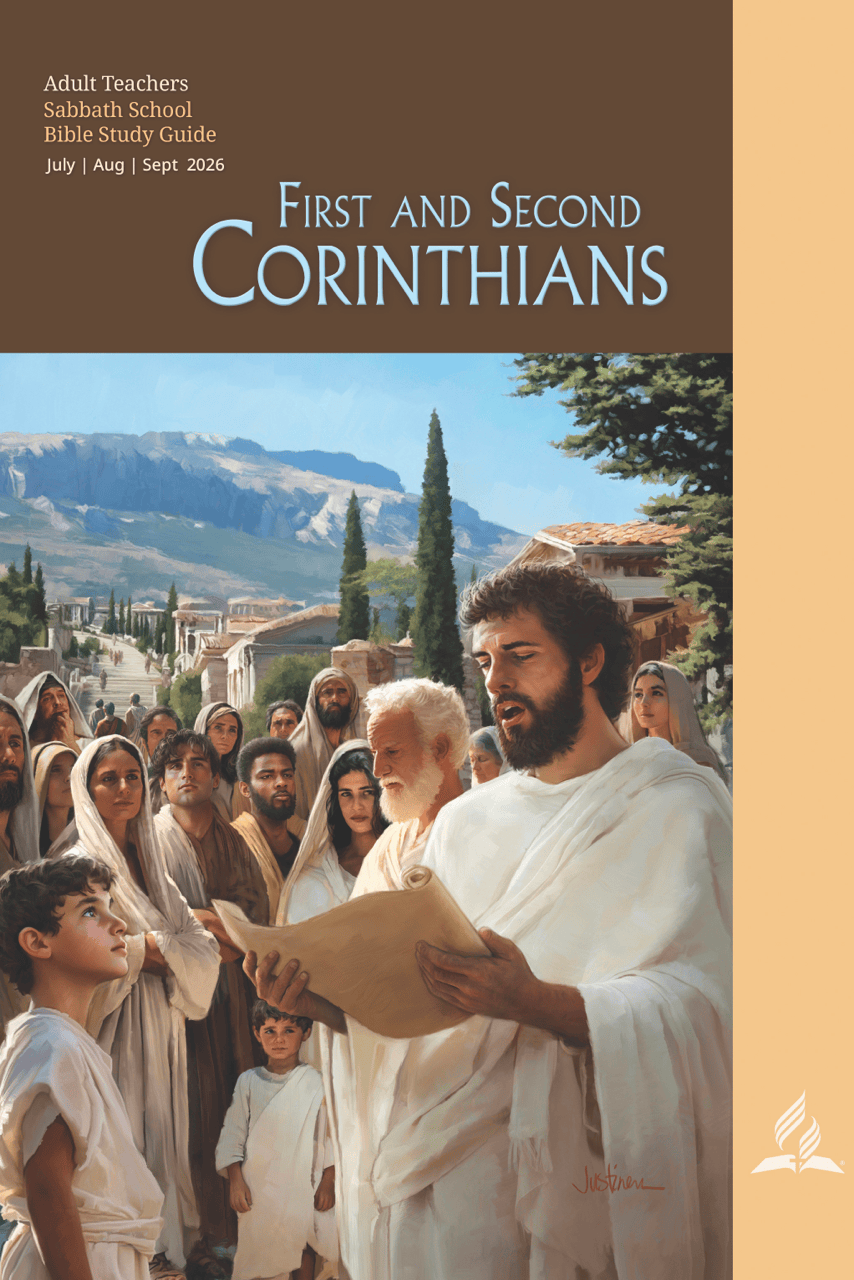
True generosity is not a financial transaction but a spiritual echo of Jesus, who gave everything so that we could receive everything.
Whoever you are
Whether or not you have ever set foot in an Adventist church, this lesson asks a question every human being wrestles with: why should I be generous, especially when I have little? The answer Paul offers is not a financial strategy but a story — the story of a God who gave up everything for people who could give nothing in return. That reframes generosity from an obligation into a response, and from a burden into a joy available to anyone, rich or poor, religious or not.
The week, day by day
The language of heaven is the language of giving — 'God so loved the world that He gave' — and human stewardship is designed to reflect that same divine grammar.
The Macedonian churches gave out of extreme poverty with overflowing generosity, showing that the size of your wallet never determines the size of your heart — because real generosity imitates Christ, who left infinite riches to become poor for our sake ().
Paul identifies at least four motivations for giving woven through 2 Corinthians 8–9 — gratitude for grace, solidarity with fellow believers, the glory of God, and wonder at the 'inexpressible gift' of Jesus — and every one of them is outward-looking, not self-serving.
Just as God planned salvation before the foundation of the world (), Paul calls believers to give with forethought — the Greek word proaireō means a decision made in advance — teaching us that intentional, pre-decided generosity honours the God who never improvises.
The Macedonians gave with 'abundant joy' — the Greek root behind 'cheerful giver' carries the sense of gladness and eagerness, not grudging duty — reminding us that the attitude we bring to giving matters as much to God as the amount we give.
Paul's collection was not merely charitable — it was ecclesial and missional: Gentile churches sending funds to Jewish believers in Jerusalem was a living demonstration that old dividing walls were gone, and that generosity can be one of the most powerful sermons a church ever preaches.
Ellen White captures the lesson's core: when believers take their affections off the things of this world and make sacrifices for the gospel, the truths they proclaim carry a power that arguments alone never can — generosity authenticates proclamation.
In depth
There is a single sentence in all of Scripture that most Christians can recite from memory: 'For God so loved the world that He gave.' is not merely a soteriological statement — it is a portrait of the divine character. God's most instinctive movement toward a broken world was not to withdraw, not to demand, but to give. This week's lesson plants that truth like a seed at the beginning of its exploration of stewardship, and then watches it grow across two of Paul's most practically theological chapters: 2 Corinthians 8 and 9.
The backstory matters here. Paul is writing to the church in Corinth — a congregation he loves dearly but also one that has given him more heartache than perhaps any other. They had made a generous promise to help the suffering believers in Judea, and then life got complicated. Relationship tensions with Paul, theological distractions, perhaps plain old busyness — whatever the cause, the offering had stalled. So Paul, having spent seven chapters mending the relationship, turns in chapters 8 and 9 to complete unfinished business. But notice how he does it. He doesn't guilt them. He doesn't threaten. He points them first to the Macedonians — a church so poor they could barely afford their own bread — who begged for the privilege of giving. And then, above even that remarkable example, he points to Jesus, who being rich beyond all reckoning, 'became poor' so that through His poverty we might become rich (). The Macedonians were generous because they had first given themselves to the Lord (). Their giving flowed from surrender, not from surplus.
The lesson draws out four motivations Paul weaves through these chapters, and they are worth sitting with. Gratitude comes first — not obligation. The Greek word for 'grace' (charis) and the word for 'gift' (charis again) are the same. When you understand what you've been given, generosity becomes the most natural response in the world. Then there is planning: Paul uses the Greek proaireō, a compound verb meaning 'to decide in advance.' This is not impulsive giving born of emotional pressure but thoughtful, intentional stewardship. God Himself modeled this — the lamb was slain 'from the foundation of the world' (). Salvation was not a crisis response; it was a planned gift. Third comes attitude — specifically joy. The Greek word hilaros, translated 'cheerful,' is where we get our English word 'hilarious.' It suggests giving that is so wholehearted it is almost exuberant. And finally, Paul's collection served a profound purpose of unity: Gentile believers in Corinth and Macedonia sending support to Jewish believers in Jerusalem. This was not just financial aid; it was embodied theology — a demonstration that the dividing wall of hostility had truly been torn down.
For those unfamiliar with Adventist teaching, it's worth noting that Seventh-day Adventists understand stewardship broadly. Everything — time, talent, finances — belongs to God, and we are caretakers of what He has entrusted to us. Giving financially is one expression of that stewardship, but it flows from a prior act: giving ourselves, as the Macedonians did. Ellen White captures this beautifully in The Acts of the Apostles, observing that when believers genuinely surrender their affections from the things of the world, their sacrificial giving becomes its own powerful witness. The offering plate, rightly understood, is a theology statement — it says, 'I believe this good news enough to invest in its spread.'
What makes this lesson quietly radical is its insistence that giving is a privilege, not a tax. Paul calls participation in the Jerusalem offering a 'grace' — the same word used for God's unmerited favour toward us. In a world where financial appeals are often met with suspicion, this reframing is liberating. You are not being squeezed; you are being invited into the family resemblance of a God whose most defining act was to give. The question the lesson leaves with us is not 'how much should I give?' but 'have I given myself first?' Everything else flows from that.
The Miners Who Gave What They Didn't Have
In the late nineteenth century, a small mining community in rural Wales heard a visiting preacher describe the desperate need of overseas mission work. The congregation was poor — genuinely, measurably poor. Most men worked underground for wages that barely covered rent and bread. When the offering was taken, something unexpected happened. A young miner stood up and walked forward. He placed his weekly wage envelope — unopened — into the plate. Then he sat down, and one by one, others did the same. The visiting minister was stunned. Afterward, he asked the young miner why he had given everything. The miner smiled and said simply, 'I gave myself to God a long time ago. The money just goes where I go.'
Other voices
White observes that when believers genuinely detach their hearts from worldly things and are willing to sacrifice so that others may hear the gospel, the message they proclaim carries a persuasive power that argument alone cannot produce — the life itself becomes the sermon.
Knight, in his work on Adventist theology and community, emphasizes that Paul's collection for Jerusalem was not merely humanitarian charity but an act of ecclesiological significance — it was a living demonstration that the body of Christ crosses every ethnic and economic boundary, making the offering itself a form of proclamation.
Paulien notes that in John's Gospel, giving is the primary lens through which God's love is defined — not as sentiment but as costly, self-emptying action. This makes the theological foundation for all Christian stewardship: generosity is not a human virtue we cultivate but a divine character trait we reflect.
Take it with you
Before the offering plate arrives, decide prayerfully in advance what you will give — planned generosity is a form of worship, not just a financial habit.
Examine your motivation for giving: is it guilt, social pressure, or a genuine response to the grace you have already received? Grace-driven giving is self-sustaining; duty-driven giving burns out.
Look for ways your giving can build bridges — supporting a fellow believer, a struggling church, or a community in need is not just charity, it is a visible argument that the family of God is real.
What is Sabbath School?
Sabbath School is part of Adventist worship, held before the main service each Saturday. Its purpose is simple: to read the Bible together and understand it better.
Each week has a topic, and the same lesson is studied worldwide. What makes it distinctive is how it is discussed — deliberately in small groups rather than one large gathering, so everyone present can take part. People share what they noticed, ask the questions they are actually carrying, and work through the passage together. Nobody is only listening.
The aim is not to arrive at a single answer but to send everyone away knowing the Bible a little better than they did that morning. You do not need to be Adventist to follow along, and you do not need to have read anything beforehand.
This overview was made to make the week’s Sabbath School reading clearer. It is based on the official Adult Bible Study Guide published by the General Conference of Seventh-day Adventists, and is meant to be read alongside the lesson, not in place of it.
The overview, its structure and its commentary were developed for the Christo Samuel Sabbath School app and this site. They are not to be copied, reproduced or republished elsewhere. If you spot an error, please let me know — I am always glad to correct it.
Lesson content © General Conference of Seventh-day Adventists · Adult Bible Study Guide. Overview and commentary © 2026 Christo Samuel.
The daily readings
The lesson itself, day by day, as published in the Adult Bible Study Guide. Tap any reference to read the passage.
Sab 5 Sep Stewardship and Mission
Read for This Week’s Study 2 Corinthians 8–9; ; ; ; ; ; , .
Memory Text: “For you know the grace of our Lord Jesus Christ, that though He was rich, yet for your sakes He became poor, that you through His poverty might become rich” (, NKJV).
Second Corinthians 8 and 9 show that Paul gave the Corinthians the opportunity to serve their brothers and sisters in Judea. This passage shows that giving is a privilege that God grants us, so that we can emulate the self-giving character of Christ. The language of heaven is one of giving. Notice these remarkable words: “For God so loved the world that He gave His only begotten Son” (, NKJV; emphasis supplied).
Furthermore, clearly expresses God’s purpose in giving Jesus, so that “whoever believes in Him should not perish but have everlasting life” (NKJV). Stewardship and mission go together in this passage. They are as inseparable as the two sides of a coin. It is no wonder that Paul identifies himself and his fellow workers as “stewards of the mysteries of God” (, NKJV). We, too, are stewards in the same sense.
This week we will see that the concepts of stewardship and mission are deeply rooted in the example of Jesus. Indeed, stewardship and mission are inseparable. Stewardship provides the church with financial and human resources to fulfill God’s mission.
*Study this week’s lesson to prepare for Sabbath, September 12.
---
Selected Quotes from Ellen G. White
In every action of life the true Christian is just what he desires those around him to think he is. He is guided by truth and uprightness. He does not scheme; therefore he has nothing to gloss over. He may be criticized, he may be tested; but through all, his unbending integrity shines out like pure gold. He is a friend and benefactor to all connected with him, and his fellow men place confidence in him, for he is trustworthy. Does he employ laborers to gather in his harvest? He does not keep back their hard-earned money. Has he means for which he has no immediate use? He relieves the necessities of his less-fortunate brother. He does not seek to enlarge his possessions by taking advantage of the untoward circumstances of his neighbor. He accepts only a fair price for that which he sells. If there are defects in the articles sold, he frankly tells the buyer, even though by so doing he may seem to work against his own pecuniary interests. . . . Satan knows full well what a power for good is the life of a man of unbending integrity, and he puts forth zealous efforts to prevent men from living such lives. He comes to them with alluring temptations, promising them wealth, position, worldly honor, if they will but yield the principles of righteousness. And he has much success. . . . From the sad history of many who have failed we learn the danger of prosperity. It is not those who have lost their property who are in greatest danger, but those who have obtained a fortune. . . . Prayer is often requested for men and women in affliction, and this is right. But those in prosperity are more in need of the prayers of God’s servants, for they are in greater danger of losing salvation. In the valley of humiliation men walk securely while they reverence God and make Him their trust. On the lofty pinnacle, where praise is heard they need the help of special power from above.—In Heavenly Places, p. 243.
God’s work must be sustained by tithes and gifts and offerings. The Lord now calls for the means that He has entrusted to His stewards. There should be a constant stream flowing into the treasury, that the work may not be hindered. To some, God has entrusted earthly riches to be held in trust and to be returned to Him as they may be required to carry forward His work in the earth. He requires from His stewards a faithful tithe of all their capital, and in addition to the tithe, He calls for gifts and offerings. The Lord Jesus requires nothing more from His followers than He Himself has performed. Those who practice self-denial and self-sacrifice for the cause of God are but following His example. He laid off His royal robe and kingly crown, and stepped down from His high command. He became poor, that through His poverty we might come into possession of the eternal treasures. He gave not only His riches, but His own life in self-denial and self-sacrifice, that He might remove every hindrance from those who seek an entrance into the kingdom of God. . . . The Lord Jesus invites us to become laborers together with Him. He is the owner of and has claims upon all that we possess. By our willingness to help in His work, we may now show our love for Him.—The Upward Look, p. 113.
Sun 6 Sep The Example of Jesus
The context of 2 Corinthians 8 and 9 has to do with Paul’s encouraging members in Corinth to complete a fundraiser for the impoverished churches in Judea. Apparently, they had already committed to doing that (, ; ; see also ), but relationship issues between them and Paul had complicated things. After dealing with these issues (2 Corinthians 1–7), Paul now turns to the conclusion of that task (2 Corinthians 8–9).
Initially, Paul appeals to the example of the Macedonians (), whose extreme poverty did not prevent them from overflowing “in a wealth of generosity” (, ESV). Yes, poverty and generosity can walk together. However, this admirable generosity of the Macedonians is but a replication of Jesus’ generosity in giving Himself for us ().
Read . What does this passage tell us about the example of Jesus?
Paul’s statement in is one of the most astonishing, powerful, and profound passages in the whole Bible. Paul tells the story of Jesus’ mission but with an incredible economy of words. There is so much theology here. This is the story of redemption but in only one verse.
Even more impressive is that this story is told through financial language. Yes, Jesus was rich. His richness refers to His pre-existence in heaven (). He decided to become poor by giving up the heavenly glory and coming to this world of sorrows. He became literally poor (). Although He was equal with God, He “emptied Himself by taking the form of a bond-servant and being born in the likeness of men” (, NASB). “And being found in human form, he humbled himself by becoming obedient to the point of death, even death on a cross” (, ESV).
Jesus gave His own life so that we might live forever with Him. His offering had a purpose: our salvation. Stewardship and mission go together. Second Corinthians 8–9 tells the story of a particular money offering, but this story is based upon Jesus. During this week, we will see theological principles related to the practice of offering gifts that are based on Christ’s offering of Himself.
Dwell on the birth, life, death, and resurrection of Jesus. When you realize that all this was done for you so that you can have hope of something beyond this miserable existence here, what should your reaction be?
---
Selected Quotes from Ellen G. White
Those who would at last be received into heaven as members of the royal family must here give themselves, body, soul, and spirit, to the service of Him who paid the price of their redemption. All that we have and are belongs to the Lord. “Ye are not your own,” the apostle declares. “For ye are bought with a price: therefore glorify God in your body, and in your spirit, which are God’s” (, ). . . . Have you consecrated yourself wholly to the Lord? Can He use you as a vessel unto honor? Are you faithfully acting your part in His cause? To every man God has given his work. He expects every believer to cooperate with Him in the work of soul-saving. When His cause is suffering for means, how can anyone set a price on his services, refusing to take up the cross daily, and practice self-denial for Christ’s sake? The fulfillment of the promise that we shall be joint-heirs with Christ rests upon our willingness to deny self. When Christ takes possession of His kingdom, it will be those who on this earth have followed Him in self-denial and sacrifice who will receive the reward of everlasting life. Christ’s call to sacrifice and unreserved surrender means crucifixion of self. In order to obey this call, we must have unquestioning faith in Him as the perfect Example, and we must have a clear realization that we are to represent Him to the world. Those who work for Christ are to work in His lines. They are to live His life. His call to unreserved surrender is to be to them supreme. They are to allow no earthly tie or interest to prevent them from giving Him the homage of their hearts and the service of their lives. Earnestly and untiringly they are to labor with God to save perishing souls from the power of the tempter. Those who are thus connected with Christ learn constantly of Him, passing through the successive stages of progress in Christian experience. Difficulty and perplexity come to them, that they may learn more perfectly the will and way of Christ. But they pray and believe, and by exercise their faith increases. “Take my yoke upon you,” Christ said, as in human nature He lived and worked upon this earth. Constantly He wore the yoke of submission, meeting the difficulties that human beings must meet, bearing the trials that they must bear. The enemy will continually assault us as he assaulted Christ, bringing against us strong temptation. But for everyone there is a way of escape.—The Upward Look, p. 235.
Mon 7 Sep Motivation
Read , and , , , . What is the central message of these passages?
The language of giving pervades 2 Corinthians 8 and 9: “The grace of God . . . has been given” (, ESV); “They gave themselves” (, ESV); “Each of you should give what you have decided in your heart . . . , for God loves a cheerful giver” (, NIV); “He has given to the poor” (, ESV); “They will glorify God because of . . . the generosity of your contribution” (, ESV); “Thanks be to God for his inexpressible gift!” (, ESV). Second Corinthians 8 and 9 begin and end with the language of giving ( and ). We must read these two chapters with the idea of giving in mind. They present at least four major reasons for giving our offerings.
Gratitude for God’s grace (; , ). Second Corinthians 8–9 begins with a reference to “the grace of God” (). A little further, Paul says, “You know the grace of our Lord Jesus Christ” (, ESV). The grace of God and Christ is presented here as one’s primary reason for the practice of offering. God did so much for us by giving us Christ. By offering our gifts in return, we recognize the grace of God in our lives.
As with the concept of giving, the term “grace” (in Greek, charis) also occurs repeatedly in 2 Corinthians 8–9. Likewise, the word charis occurs at the beginning and the end of this passage (; , ). Paul applies this term with different meanings in the passage to emphasize that the grace of Christ in our lives results in grace for others and for thanksgiving.
Desire to follow the example of Jesus (). Jesus was rich and became poor (remember that these are symbols for His eternal pre-existence and then coming into humanity, respectively). There is only one way for that to have happened: He gave all. As for us, by sharing our offerings, we provide means for others to know Christ.
Desire to share God’s blessings (, ). We give to others only because we first received from God. He enriches us so that we can be generous.
Sincere love (, ). Giving is the test of sincere and genuine love. It is the most substantial evidence that love dwells in one’s heart. To use an English expression, it is to “put your money where your mouth is.”
How generous are you? In light of the Cross, how much do you give in contrast to what you could give?
---
Selected Quotes from Ellen G. White
The life of Christ was an ever-widening, shoreless influence, an influence that bound Him to God and to the whole human family. Through Christ, God has invested man with an influence that makes it impossible for him to live to himself. Individually we are connected with our fellow men, a part of God’s great whole, and we stand under mutual obligations. No man can be independent of his fellow men; for the well-being of each affects others. It is God’s purpose that each shall feel himself necessary to others’ welfare, and seek to promote their happiness. . . . By the atmosphere surrounding us, every person with whom we come in contact is consciously or unconsciously affected. . . . Our words, our acts, our dress, our deportment, even the expression of the countenance, has an influence. . . . If by our example we aid others in the development of good principles, we give them power to do good. In their turn they exert the same influence upon others, and they upon still others. Thus by our unconscious influence thousands may be blessed. . . . Character is power. The silent witness of a true, unselfish, godly life carries an almost irresistible influence. By revealing in our own life the character of Christ we co-operate with Him in the work of saving souls. It is only by revealing in our life His character that we can co-operate with Him. And the wider the sphere of our influence, the more good we may do. When those who profess to serve God follow Christ’s example, practicing the principles of the law in their daily life; when every act bears witness that they love God supremely and their neighbor as themselves, then will the church have power to move the world. But never should it be forgotten that influence is no less a power of evil. To lose one’s own soul is a terrible thing; but to cause the loss of other souls is still more terrible. . . . It is only through the grace of God that we can make a right use of this endowment.—God’s Amazing Grace, p. 231.
The religion of Jesus Christ works a reformation in life and character. The true Christian seeks constantly for the grace that changes the objectionable features of the natural character. Instead of speaking sharp, dictatorial words, he speaks the words of encouragement that Christ would speak were He in his place. He shows benevolence to all, not only to the few who may flatter him and exalt his wisdom. The purity and holiness revealed in Christ’s life radiates from the life of the true Christian. Christians are to be light bearers in the world, shining amid the darkness of sin and crime. In the kingdom of this world, the principalities and powers that take Satan as their leader must constantly be met. Following Christ’s example of cross bearing and self-denial makes those who receive Christ children of God. “As many as received him, to them gave he power to become the sons of God, even to them that believe on his name” (). They are victors in the battle of life; for they have put on the new man, “which is renewed in knowledge after the image of him that created him” ().—The Upward Look, p. 75.
Tue 8 Sep Planning
Read . What does this passage say about the act of offering?
God’s decision to save the world took place even before the world fell into sin. Christ’s coming to die for us was part of an ancient plan (). God was not caught by surprise. He had made plans to give Himself through Jesus. In 2 Corinthians 8 and 9, planning is an essential theological principle that concerns the act of giving. This can be seen in at least two ways:
First, planning involves previous decision. Paul says that “each of you should give what you have decided in your heart” (, NIV). The Greek word translated as “decided” is the verb proaireō. This verb is a compound form. The particle pro means “beforehand” or “in advance,” and aireō means in this context “to decide.” Thus, proaireō points to a decision made beforehand. Also, by starting his statement with “each of you,” Paul indicates that the given amount will not be the same for everyone. His point was simply that whatever people decide to give, they should do it with careful reflection. They should give what they believe is the right amount for them to give.
Second, planning involves the principle of proportionality. Paul reports that the Macedonians “gave according to their means” (, ESV). Next, he applies this principle of proportionality to the Corinthians, as well. Encouraging them to finish the task that they had already committed to, he urges them to complete that project by using the resources that they possess (). He concludes this thought by saying that the offering is given “according to what a person has, not according to what he does not have” (, ESV). Whereas the Bible defines the proportionality of the tithes, namely, 10 percent, the same does not apply to the offerings. “Each of you should give what you have decided in your heart” (, NIV) by applying the principle of proportionality. In other words, each one decides which proportion of earnings that he or she will give as an offering. Each one is supposed to give in proportion to what one has. This cannot be done without planning.
How faithful are you with tithes and offerings, no matter how rich or poor you are? What excuses do you use to hold back from giving when you know that you can do more?
---
Selected Quotes from Ellen G. White
Those who receive Christ by faith will be looked upon by Heaven as precious pearls for which the merchantman has paid an infinite price, and the human agents who find Christ will realize that they have found a heavenly treasure. They will be anxious to sell all that they have in order to buy the field which contains this treasure. As they contemplate the love of God, as the plan of salvation opens to their view, as the mystery of Christ’s condescension becomes plainer to them, as they see the sacrifice that He made for them, they count nothing too dear to give up for His sake. The more they dwell upon the wonderful love of God, the vaster becomes its proportion, and the brightness of the glory of God becomes too glorious for mortal vision. The Lord God of heaven collected all the riches of the universe, and laid them down in order to purchase the pearl of lost humanity. The Father gave all His divine resources into the hands of Christ in order that the richest blessings of heaven might be poured out upon a fallen race. God could not express greater love than He has expressed in giving the Son of His bosom to this world. This gift was given to man to convince him that God had left nothing undone that He could do, that there is nothing held in reserve, but that all heaven has been poured out in one vast gift. The present and eternal happiness of man consists in receiving God’s love, and in keeping God’s commandments. Christ is our redeemer. He is the Word that became flesh and dwelt among us. He is the fountain in which we may be washed and cleansed from all impurity. He is the costly sacrifice that has been given for the reconciliation of man. The universe of heaven, the worlds unfallen, the fallen world, and the confederacy of evil cannot say that God could do more for the salvation of man than He has done. Never can His gift be surpassed, never can He display a richer depth of love. Calvary represents His crowning work.... The Lord would have His followers enraptured with God through the knowledge of His paternal character.—Our High Calling, p. 13.
Whenever God’s people, in any period of the world, have cheerfully and willingly carried out His plan in systematic benevolence and in gifts and offerings, they have realized the standing promise that prosperity should attend all their labors just in proportion as they obeyed His requirements. When they acknowledged the claims of God, and complied with His requirements, honoring Him with their substance, their barns were filled with plenty.—Counsels on Stewardship, p. 347.
Wed 9 Sep Attitude
Read . What possible reason could have been behind the Macedonians’ willingness to give their offerings with such generosity?
The positive attitude of the Macedonians can be seen in several ways.
First, they gave with abundant joy (). Paul says that the Macedonians’ “abundance of joy and their extreme poverty have overflowed in a wealth of generosity” (, ESV). He later mentions that “God loves a cheerful giver” (, NKJV). The Greek word rendered as “cheerful” occurs only here in the New Testament. A term from the same family occurs elsewhere: “The one who does acts of mercy [must do it] with cheerfulness” (, ESV). Terms from this word family sometimes appear in extra-biblical literature, with a sense of gladness and happiness. In , being a cheerful giver means giving without reluctance.
Second, they gave with generosity (). Before Paul mentioned the Macedonians’ generosity, he first referred to their “extreme poverty” (ESV). The word “generosity” (in Greek, haplotētos) appears twice more in 2 Corinthians 8 and 9. Paul says, “You will be enriched in every way so that you can be generous on every occasion” (, NIV; emphasis supplied), meaning that we are given so that we can then give. A little further, he mentions “the generosity of your contribution” (, ESV; emphasis supplied). In this passage, being generous in contributing is a way of confessing Christ’s gospel.
Third, they gave “of their own free will” (, NLT). This means that they gave voluntarily. This becomes even more admirable when one sees they did not give out of their surplus, for their resources were extremely limited. Paul uses the same idea to characterize Titus’s willingness to visit the Corinthians. He went to Corinth voluntarily ().
Fourth, they gave with a sense that giving is a privilege (). This attitude is perceptible in the Macedonians’ request to participate in the collection. “They urgently pleaded with us for the privilege of sharing in this service” (, NIV).
Finally, they participated in the collection as an act of total consecration (). Paul says, “They gave themselves first to the Lord and then by the will of God to us” (, ESV). Giving oneself to the Lord results in giving oneself to others. The Macedonians expanded their mission involvement beyond financial assistance. That is, giving and being generous is not limited to money alone.
---
Selected Quotes from Ellen G. White
The psalmist’s words, “The law of thy mouth is better unto me than thousands of gold and silver,” state that which is true from other than a religious point of view. They state an absolute truth, and one that is recognized in the business world. Even in this age of passion for money-getting, when competition is so sharp, and methods are so unscrupulous, it is still widely acknowledged that, for a young man starting in life, integrity, diligence, temperance, purity, and thrift constitute a better capital than any amount of mere money. . . . That which lies at the foundation of business integrity and of true success is the recognition of God’s ownership. The Creator of all things, He is the original proprietor. We are His stewards. All that we have is a trust from Him, to be used according to His direction. This is an obligation that rests upon every human being. It has to do with the whole sphere of human activity. Whether we recognize it or not, we are stewards, supplied from God with talents and facilities, and placed in the world to do a work appointed by Him. To every man is given “his work” ()—the work for which his capabilities adapt him—the work which will result in greatest good to himself and to his fellowmen, and in greatest honor to God. Thus our business or calling is a part of God’s great plan, and, so long as it is conducted in accordance with His will, He Himself is responsible for the results. “Labourers together with God” (), our part is faithful compliance with His directions. Thus there is no place for anxious care. Diligence, fidelity, care-taking, thrift, and discretion are called for. Every faculty is to be exercised to its highest capacity. But the dependence will be, not on the successful outcome of our efforts, but on the promise of God. The word that fed Israel in the desert, and sustained Elijah through the time of famine, has the same power today. “Be not therefore anxious, saying, What shall we eat? or, What shall we drink?” (, RV). . . . He who gives men power to get wealth has with the gift bound up an obligation. Of all that we acquire He claims a specified portion. The tithe is the Lord’s. . . . “Bring ye all the tithes into the storehouse” () is God’s command. No appeal is made to gratitude or to generosity. This is a matter of simple honesty. The tithe is the Lord’s; and He bids us return to Him that which is His own. “It is required in stewards, that a man be found faithful” (). If honesty is an essential principle of business life, must we not recognize our obligation to God—the obligation that underlies every other?—Lift Him Up, p. 304.
Thu 10 Sep Unity
We have seen that Paul encourages the members in Corinth to get involved in a collection for the impoverished churches in Judea. One of his purposes is to kindle a sense of unity. He wants them to participate, to be part of the mission. He wants to show that the Gentile churches are part of the same family of God as are the Jewish believers in Jerusalem. That is, these people, who were once their opponents, are now, indeed, fellow members with them in God’s new covenant remnant. Paul wants to see the whole Christian family, Jew and Gentile, united in a powerful way that can bear a witness to the church in generations to come.
Titus and two other acclaimed brothers were in charge of the funds. God put this care for the church into the heart of Titus (). Through the churches, God also chose the two other brothers (). They are called “messengers of the churches, the glory of Christ” (, NKJV). Whether “the glory of Christ” describes these two faithful brothers or the churches themselves does not matter. Giving offerings is ultimately a signal of loyalty to Christ, the Head of the church ().
Second Corinthians 8–9 indicates that the offerings should be given to people appointed by God through the church. The phrases “all the churches” (, NKJV), “chosen by the churches” (, NKJV), and “messengers of the churches” (, NKJV) suggest precisely that. Thus, the following exhortation is not surprising, “Give proof before the churches of your love” (, ESV).
Bringing offerings to the church—God’s appointed instrument on earth—promotes unity and, at the same time, is the result of a sense of unity (, ). Money can be a great unifier. On the other hand, if people’s eyes are not single to the glory of God, money can create division, as well.
How does , reveal Paul’s desire for unity here?
Finally, Paul depicts the collection as service or ministry, as an act of grace, as a blessing, as an act of worship, and also as fellowship. All that from an offering? Think about it.
How does our giving to fellow churches and missions overseas, often in faraway places, help bring unity to our world church?
---
Selected Quotes from Ellen G. White
Wherever there is life, there is increase and growth; in God’s kingdom there is a constant interchange—taking in, and giving out; receiving, and returning to the Lord His own. God works with every true believer, and the light and blessings received are given out again in the work which the believer does. Thus the capacity for receiving is increased. As one imparts of the heavenly gifts, he makes room for fresh currents of grace and truth to flow into the soul from the living fountain. Greater light, increased knowledge and blessing, are his. In this work, which devolves upon every church member, is the life and growth of the church. He whose life consists in ever receiving and never giving, soon loses the blessing. If truth does not flow forth from him to others, he loses his capacity to receive. We must impart the goods of heaven if we desire fresh blessings. As the knowledge of truth is imparted, it will increase. All who receive the gospel message into the heart will long to proclaim it. The heaven-born love of Christ must find expression. Those who have put on Christ will relate their experience, tracing step by step the leadings of the Holy Spirit—their hungering and thirsting for the knowledge of God and of Jesus Christ whom He has sent, the results of their searching of the Scriptures, their prayers, their soul agony, and the words of Christ to them, “Thy sins be forgiven thee.” It is unnatural for any to keep these things secret, and those who are filled with the love of Christ will not do so. In proportion as the Lord has made them the depositaries of sacred truth will be their desire that others shall receive the same blessing. And as they make known the rich treasures of God’s grace, more and still more of the grace of Christ will be imparted to them. They will have the heart of a little child in its simplicity and unreserved obedience. Their souls will pant after holiness and more and more of the treasures of truth and grace will be revealed to them to be given to the world.—God’s Amazing Grace, p. 63.
The graces of Christ’s Spirit must be cherished and revealed by the sons and daughters of God. By their humility, their penitence, their desire to be like Jesus, to be conformed to His will by practicing His lessons in their daily life, they honor Him. . . . “Ye are God’s husbandry” (). As one takes pleasure in the cultivation of a garden, so God takes pleasure in His believing sons and daughters. A garden demands constant labor. The weeds must be removed; new plants must be set out; branches that are making too rapid development must be pruned back. So the Lord works for His garden, so He tends His plants. He cannot take pleasure in any development that does not reveal the graces of the character of Christ. The blood of Christ has made men and women God’s precious charge. Then how careful should we be not to manifest too much freedom in pulling up the plants that God has placed in His garden! Some plants are so feeble that they have hardly any life, and for these the Lord has a special care. In all your transactions with your fellow men, never forget that you are dealing with God’s property. Be kind; be pitiful; be courteous. Respect God’s purchased possession. Treat one another with tenderness and courtesy. Exert every God-given faculty to become examples to others.—God’s Amazing Grace, p. 65.
Fri 11 Sep Further Thought
Read Ellen G. White, “A Liberal Church,” pp. 335–345, in The Acts of the Apostles.
“Those whose hearts are filled with the love of Christ, will follow the example of Him who for our sake became poor, that through His poverty we might be made rich. Money, time, influence—all the gifts they have received from God’s hand, they will value only as a means of advancing the work of the gospel. Thus it was in the early church; and when in the church of today it is seen that by the power of the Spirit the members have taken their affections from the things of the world, and that they are willing to make sacrifices in order that their fellow men may hear the gospel, the truths proclaimed will have a powerful influence upon the hearers.”—Ellen G. White, The Acts of the Apostles, p. 71.
“The Lord does not need our offerings. We cannot enrich Him by our gifts. Says the psalmist: ‘All things come of Thee, and of Thine own have we given Thee.’ Yet God permits us to show our appreciation of His mercies by self-sacrificing efforts to extend the same to others. This is the only way in which it is possible for us to manifest our gratitude and love to God. He has provided no other.”—Ellen G. White, Counsels on Stewardship, pp. 18, 19.
“How great was the gift of God to man, and how like our God to make it! With a liberality that can never be exceeded he gave, that he might save the rebellious sons of men and bring them to see his purpose and discern his love. Will you, by your gifts and offerings, show that you think nothing too good for Him who ‘gave his only begotten Son that whosoever believeth in him should not perish, but have everlasting life’?”—Ellen G. White, in The Advent Review and Sabbath Herald, May 15, 1900.
Dwell more on . Why is the example of Jesus so crucial as far as stewardship is concerned?
hints that the language of heaven is one of giving. Read ; , ; , ; and . What do these passages and have in common, and what message can we take from them?
Based on your reading of 2 Corinthians 8–9, what are the personal benefits of giving?
In addition to giving systematic offerings, what other things can you do to imitate Jesus’ self-giving example?
---
Selected Quotes from Ellen G. White
Our Father Cares, “The Meaning of Communion With God,” October 25, p. 310. Reflecting Christ, “What the Spirit of Liberality Will Do,” September 13, p. 270.
Lesson content © General Conference of Seventh-day Adventists · Adult Bible Study Guide.
Carry it with you
Everything here, plus the parts that only work when they are yours.
- Highlight and save any verse
- Write your own notes on every chapter
- Search by how you feel, not just by word
- A daily reading that keeps your place
Get the app
Free on both stores. Pick yours.