Sabbath School
New Testament Prophets
Quarter 4, 2026
This week's lesson traces the gift of prophecy from Moses through Jesus and into the early Christian church, examining how New Testament prophets functioned, who they were (including women), and how to guard against counterfeits. It concludes by grounding all genuine prophecy in its core purpose: pointing people to Jesus and His Word.
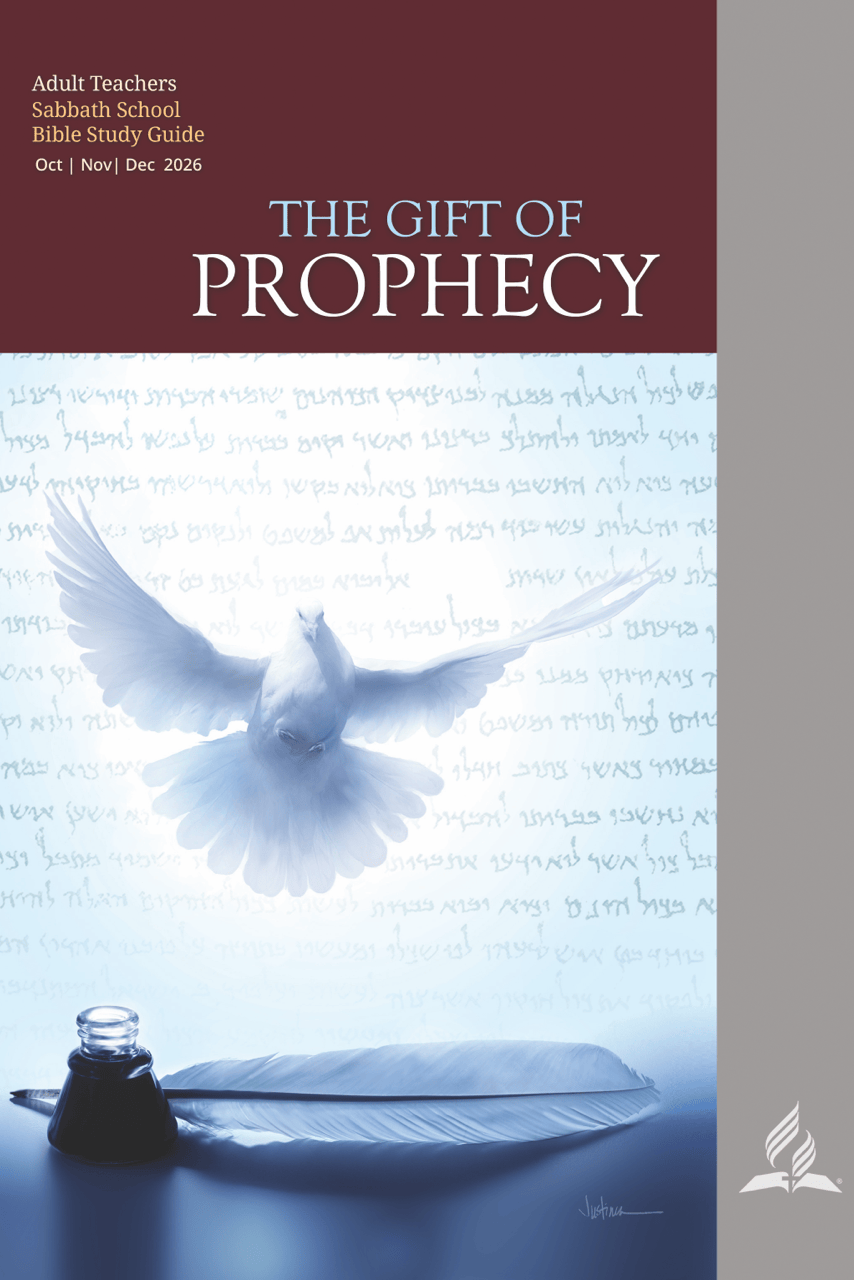
The prophetic gift, given by the same Spirit across every era, has always had one irreducible purpose — drawing human hearts into a faithful, living relationship with God through Jesus Christ.
Whoever you are
Whether or not you have ever attended a Seventh-day Adventist church, this lesson asks a question that is universally urgent: how do we know who to trust when someone claims to speak for God? In an age saturated with spiritual influencers, self-proclaimed prophets, and online voices all competing for our deepest loyalties, the New Testament's framework — test the message, watch the fruit, keep Jesus central — is as practical as it is ancient. You don't need to share Adventist convictions to find that wisdom worth holding onto.
The week, day by day
Just as an engine may remain identical even when a car's body changes, the Spirit who empowers spiritual gifts — including prophecy — remains the same God across both Testaments; the form changes, the source does not.
Moses promised a Prophet to come, and Jesus is that Prophet — not merely one voice among many, but the One to whom every earlier prophetic voice was pointing, the living fulfillment of all Messianic expectation.
Unlike the hereditary priesthood, God chose apostles and prophets purely according to His own will — a reminder that divine calling is never about family lineage or social standing, but about God's sovereign purpose.
New Testament prophets served the whole community of faith through edification, exhortation, and comfort — their gift was not primarily about spectacular prediction but about building people up and equipping the church for maturity.
Anna the prophetess and Philip's four daughters demonstrate that God has always entrusted women with the prophetic gift; their lives of prayer, fasting, and testimony stand as quiet, powerful models of Spirit-led ministry.
Jesus warns that end-time deceptions will be so convincing — complete with signs and wonders — that even the spiritually serious could be misled; supernatural events alone are never sufficient proof of divine origin, because we face supernatural adversaries.
Ellen White's ministry illustrates what every genuine prophet ultimately does: she kept Jesus at the center and pointed constantly back to Scripture, beginning and ending her major literary work with the simple declaration 'God is love.'
In depth
This week's lesson traces the prophetic gift from its Old Testament roots all the way through the New Testament, and it begins with the most stunning claim of all: Jesus Himself is the great Prophet Moses foretold. When Moses told Israel that God would raise up 'a Prophet like me from your brethren' (), he was planting a signpost centuries before its fulfillment. The disciples recognized it in real time — when Jesus asked 'Who do people say I am?' the answers flew back: Elijah, Jeremiah, one of the prophets. Peter's answer, 'You are the Christ,' cuts deeper still. Jesus is not merely one prophet among many; He is the one to whom every prophet pointed. This matters enormously because it means that the prophetic gift, across both Testaments, forms a unified story rather than two disconnected eras. The 'engine,' to borrow the lesson's opening car analogy, stays the same even as the vehicle changes shape.
The lesson then moves to the apostles, a word meaning 'ones sent forth.' Paul is a fascinating case study here. He didn't walk with Jesus during the earthly ministry, yet he calls himself an apostle twelve times in his letters, and he defends that calling with real passion when critics challenge it. What grounds his authority? Not institutional appointment — he insists it came 'through the will of God.' This is the pattern the lesson highlights: prophets and apostles were never chosen by heredity or committee. God appointed them directly, in contrast to the Levitical priesthood which passed from father to son. That direct, sovereign appointment is itself a kind of theological statement: the Spirit moves where it will, and no human structure fully contains it.
The functions of New Testament prophets, the lesson explains, are strikingly continuous with the Old Testament. First Corinthians 14:3 gives us a beautifully practical summary: prophets speak edification, exhortation, and comfort. These aren't flashy words. Edification means building people up. Exhortation means coming alongside someone to urge them forward. Comfort means consoling the grieving and frightened. Ephesians 4 adds that these gifts exist so that the body of Christ might be 'equipped' and brought to maturity — not so that one person can dazzle a crowd. This is a profoundly communal vision of prophecy. The gift is given to a person, yes, but it is given for the benefit of everyone around them.
The lesson's Wednesday section is one of the most quietly striking: women held the prophetic gift in both Testaments, and the New Testament names them without apology. Anna, aged and faithful, stationed in the temple, is called a 'prophetess' — the first to receive that title in the New Testament. Philip's four daughters prophesied. Early church historians like Eusebius tracked their later lives, a sign that the early church considered them significant enough to remember. The lesson is careful not to overstate what we know about the content of their ministry, but the fact of their calling is plain. God's Spirit was not distributed along gender lines.
The lesson closes on a sobering note and a hopeful one simultaneously. Jesus warns with unusual urgency that false prophets will perform genuine signs and wonders — not sleight of hand, but real supernatural phenomena. Paul's framing in Ephesians 6 reminds us why: we are not wrestling against human tricksters but against organized spiritual opposition. Supernatural origin alone cannot validate a message. This is why the lesson's Friday reflection on Ellen White is so instructive: her ministry, the lesson notes, had two primary functions — to lead people to Jesus and to point them to the Bible. That double tether — Christ and Scripture — is itself a kind of discernment test. A prophet who directs you toward themselves rather than toward Jesus and the Word has already told you something important about their source.
The Signpost That Became the Destination
In the hill country of Judea, shepherds used to mark the path to the city with stacked stones — cairns that pointed travelers in the right direction. A traveler would follow one cairn, then the next, then the next, until the city gates finally came into view. The cairns were not the destination; they were pointers to it. If a traveler stopped at a cairn and refused to go further, everyone would think him confused. The whole point of the cairn was to be surpassed.
The Old Testament prophets were like those cairns — each one pointing forward, each one saying, in their own voice and era, 'Keep going; He is coming.' Isaiah described a suffering servant. Micah named the town of His birth. Moses said, 'One like me, but greater.' And then, in the fullness of time, the destination arrived in person. The cairns had done their work. Jesus did not abolish the prophets; He was what they were all pointing at.
What is remarkable is that the New Testament prophets — Anna, Philip's daughters, the prophets in Corinth — were then given the task of pointing back to that same destination for everyone who came after. The cairns now pointed to a Person who had already walked the path and left the road open. This is why the lesson insists that the authentic prophetic gift, in every age, directs people toward Jesus and His Word. The moment a 'prophet' becomes their own destination, the cairn has been mistaken for the city.
Other voices
Ellen White understood the prophetic calling as fundamentally Christ-centered — growth in grace, joy, and usefulness all flow from daily communion with Jesus, not from any external gift or office. She saw her own ministry as a signpost pointing people to Him rather than to herself.
Paulien has observed that the New Testament treats prophecy as a community-sustaining gift rather than a solo performance — its purpose is always measured by whether it builds up the gathered body and draws people deeper into the story of Scripture, not by whether it produces impressive phenomena.
Knight notes that Paul's defense of his apostolic authority is grounded not in institutional recognition but in the transforming effect of his ministry among real people — the changed lives of his converts were, he argued, his credentials. This pattern applies broadly to evaluating any prophetic claim.
Take it with you
Test every claimed prophetic voice against Scripture and its fruit — does it consistently lead people toward Jesus and His Word, or away from them?
Do not be rattled by impressive signs; cultivate deep enough familiarity with Jesus through Bible study and prayer that counterfeit voices sound obviously hollow.
Recognise that spiritual gifts — prophecy, teaching, encouragement — are given for the community's benefit, not personal prestige, so look for ways your own gifts can build others up this week.
What is Sabbath School?
Sabbath School is part of Adventist worship, held before the main service each Saturday. Its purpose is simple: to read the Bible together and understand it better.
Each week has a topic, and the same lesson is studied worldwide. What makes it distinctive is how it is discussed — deliberately in small groups rather than one large gathering, so everyone present can take part. People share what they noticed, ask the questions they are actually carrying, and work through the passage together. Nobody is only listening.
The aim is not to arrive at a single answer but to send everyone away knowing the Bible a little better than they did that morning. You do not need to be Adventist to follow along, and you do not need to have read anything beforehand.
This overview was made to make the week’s Sabbath School reading clearer. It is based on the official Adult Bible Study Guide published by the General Conference of Seventh-day Adventists, and is meant to be read alongside the lesson, not in place of it.
The overview, its structure and its commentary were developed for the Christo Samuel Sabbath School app and this site. They are not to be copied, reproduced or republished elsewhere. If you spot an error, please let me know — I am always glad to correct it.
Lesson content © General Conference of Seventh-day Adventists · Adult Bible Study Guide. Overview and commentary © 2026 Christo Samuel.
The daily readings
The lesson itself, day by day, as published in the Adult Bible Study Guide. Tap any reference to read the passage.
Sab 17 Oct New Testament Prophets
Read for This Week’s Study , , , , , .
Memory Text: “There are diversities of gifts, but the same Spirit. There are differences of ministries, but the same Lord. And there are diversities of activities, but it is the same God who works all in all” (, NKJV).
As a father was driving, his son scanned the cars passing by in order to spot those that were the same as his dad’s. The father then pointed to a car and exclaimed, “Son, that was the same as my first car!” When they got home, the father pulled out the owner’s manual to his first car, along with the manual to the current car. He carefully showed his son the features of each vehicle, highlighting things that were alike and what had been changed. However, when the father compared the two engines, everything was identical. Much had changed, but not the engine.
God spoke through prophets in the Old and New Testaments, and the continuity and harmony in their messages is because the Holy Spirit—the Source, or “Engine,” of divine inspiration—has remained the same. The Holy Spirit always empowers true prophets through the gift of prophecy. He also places Christ at the center of the prophets’ messages, as Hebrews makes clear ().
This week we will examine the gift of prophecy in the New Testament, looking at who functioned as prophets, what prophets did, how prophets compared to apostles, and the danger of false prophets, as well.
*Study this week’s lesson to prepare for Sabbath, October 24.
---
Selected Quotes from Ellen G. White
The whole Bible is a revelation, for all revelation to human beings comes through Christ and all centers in Him. God has spoken unto us by His Son, whose we are by creation and by redemption. Christ came to John, exiled on the isle of Patmos, to give him the truth for these last days, to show him that which must shortly come to pass. Jesus Christ is the great trustee of divine revelation. It is through Him that we have a knowledge of what we are to look for in the closing scenes of this earth’s history. . . . John, the beloved disciple, was the one chosen to receive this revelation. He was the last survivor of the first chosen disciples. Under the New Testament dispensation he was honored as the prophet Daniel was honored under the Old Testament dispensation. The instruction to be communicated to John was so important that Christ came from heaven to give it to His servant, telling him to send it to the churches. This instruction is to be the object of our careful and prayerful study, for we are living in a time when persons who are not under the teaching of the Holy Spirit will bring in false theories. . . . After the passing of the time [1844], God entrusted to His faithful followers the precious principles of present truth. . . . Those who passed through these experiences are to be as firm as a rock to the principles that have made us Seventh-day Adventists. . . . Those who took part in the establishment of our work upon a foundation of Bible truth, those who know the way marks that have pointed out the right path, are to be regarded as workers of the highest value. They can speak from personal experience regarding the truths entrusted to them. These workers are not to permit their faith to be changed to infidelity; they are not to permit the banner of the third angel to be taken from their hands. They are to hold the beginning of their confidence firm unto the end. The Lord has declared that the history of the past shall be rehearsed as we enter upon the closing work. Every truth that He has given for these last days is to be proclaimed to the world. Every pillar that He has established is to be strengthened. We cannot now step off the foundation that God has established. We cannot now enter into any new organization, for this would mean apostasy from the truth.—Christ Triumphant, p. 367.
Sun 18 Oct Jesus as Prophet
Moses predicted that “ ‘the Lord your God will raise up for you a Prophet like me from your midst, from your brethren. Him you shall hear’ ” (, NKJV). Who was the prophet? Scripture itself makes it clear: it was pointing to Jesus Himself. “ ‘For Moses truly said to the fathers, “The Lord your God will raise up for you a Prophet like me from your brethren. Him you shall hear in all things, whatever He says to you” ’ ” (, NKJV; see also ).
What is the prophetic role of Jesus? How was this question answered in Jesus’ time? (, , ).
Jesus, as the Christ, the Messiah, is the One to whom all the Old Testament prophets pointed. In the New Testament, Jesus is recognized as the fulfillment of their Messianic prophecies. In , He presents Himself as the One to whom the Messianic prophecies pointed.
In fact, in , the description given of the Word here does not fit any human being or mere human prophet. The Word is identified as the Creator, for “all things were made through Him, and without Him nothing was made that was made” (, NKJV). That is, He created all that was created, which is the entire cosmos, now estimated to be 93 billion light-years wide.
In every “and God said” of Genesis 1, we hear Jesus speaking. He who said, “Let there be light” () is also the “light of men” (), and through the plan of salvation (, ), He was dispelling earth’s darkness.
God’s prophetic words are certain and confirmed. When heeded, they are “a light that shines in a dark place, until the day dawns and the morning star rises in your hearts” (, NKJV). Prophecy will continue to bring light to our sinful world until Jesus, “the Morning Star,” and Source of that prophetic light, will usher in His eternal kingdom.
Until then, through His life, death, and resurrection, Christ offers us all eternal life. The only question is whether or not we will accept it.
Dwell on the fact that Jesus, the Creator (), is also the One who died on the cross for your sins. What does this amazing truth teach about the reality of God’s love for us?
---
Selected Quotes from Ellen G. White
By curing Simon of leprosy, Christ had saved him from a living death. But now Simon questioned whether the Saviour were a prophet. Because Christ allowed this woman to approach Him, because He did not indignantly spurn her as one whose sins were too great to be forgiven, because He did not show that He realized she had fallen, Simon was tempted to think that He was not a prophet. Jesus knows nothing of this woman who is so free in her demonstrations, he thought, or He would not allow her to touch Him. But it was Simon’s ignorance of God and of Christ that led him to think as he did. He did not realize that God’s Son must act in God’s way, with compassion, tenderness, and mercy. Simon’s way was to take no notice of Mary’s penitent service. Her act of kissing Christ’s feet and anointing them with ointment was exasperating to his hardheartedness. He thought that if Christ were a prophet, He would recognize sinners and rebuke them. To this unspoken thought the Saviour answered: “Simon, I have somewhat to say unto thee. . . . There was a certain creditor which had two debtors: the one owed five hundred pence, and the other fifty. And when they had nothing to pay, he frankly forgave them both. Tell Me therefore, which of them will love him most? Simon answered and said, I suppose that he, to whom he forgave most. And He said unto him, Thou hast rightly judged.” As did Nathan with David, Christ concealed His home thrust under the veil of a parable. He threw upon His host the burden of pronouncing sentence upon himself. Simon had led into sin the woman he now despised. She had been deeply wronged by him. By the two debtors of the parable, Simon and the woman were represented. Jesus did not design to teach that different degrees of obligation should be felt by the two persons, for each owed a debt of gratitude that never could be repaid. But Simon felt himself more righteous than Mary, and Jesus desired him to see how great his guilt really was. He would show him that his sin was greater than hers, as much greater as a debt of five hundred pence exceeds a debt of fifty pence. Simon now began to see himself in a new light. He saw how Mary was regarded by One who was more than a prophet. He saw that with keen prophetic eye Christ read her heart of love and devotion. Shame seized upon him, and he realized that he was in the presence of One superior to himself. “I entered into thine house,” Christ continued, “thou gavest Me no water for My feet;” but with tears of repentance, prompted by love, Mary hath washed My feet, and wiped them with the hair of her head. “Thou gavest Me no kiss: but this woman,” whom you despise, “since the time I came in hath not ceased to kiss My feet.” Christ recounted the opportunities Simon had had to show his love for his Lord, and his appreciation of what had been done for him. Plainly, yet with delicate politeness, the Saviour assured His disciples that His heart is grieved when His children neglect to show their gratitude to Him by words and deeds of love.—The Desire of Ages, pp. 566, 567.
Mon 19 Oct Apostles and Prophets
The New Testament mentions the work of prophets and apostles. The apostles were “messengers,” or “ones sent forth” from God, as defined by the Greek word apostolos. Throughout the Gospels, the word “apostle” refers to the 12 disciples. The rest of the New Testament supports this idea and includes other individuals who were not among Christ’s original disciples.
Paul calls himself an apostle 12 times in his epistles. In , , he connects his apostolic calling, and the content of his preaching, with the message of the Old Testament prophets. Paul presents himself as an apostle to the Gentiles (). He was appointed “through the will of God” ().
Unlike the priests who followed a familial line from fathers to sons, God appointed prophets and apostles according to His will. When Paul’s apostleship was in dispute, he defended his calling (, ). Paul saw his apostleship as building upon the work of Christ, the Foundation of the church (). As recipients of God’s revelation, the apostles therefore possess the same level of inspiration as the prophets ().
In , , Peter makes reference to prophets as those who came before and whose words were important, but now the apostles are presented as carrying the same authority. In these verses, reference is made to Old and New Testament times. While prophets may seem to be God’s messengers of the Old Testament era and apostles God’s messengers of the New Testament era, there were also people who prophesied or exercised the prophetic gift but who were not apostles. The gift of prophecy was not limited to the apostles in New Testament times. And not all prophets were apostles ().
Read and . How do apostles and prophets function in relation to Christ and the church?
And as we also know from reading what the apostles in the New Testament wrote, Jesus was the center of almost all that they wrote. In one way or another, His life, death, resurrection, high-priestly ministry, and return were their central focus.
The Bible is the only official record we have of the words of the apostles and prophets about Jesus, His life, and works. What should this tell us about why the Bible must have final authority for what we believe about Jesus and His death for us?
---
Selected Quotes from Ellen G. White
The Lord Jesus is making experiments on human hearts through the exhibition of His mercy and abundant grace. He is effecting transformations so amazing that Satan. . . stands viewing them as a fortress impregnable to his sophistries and delusions. They are to him an incomprehensible mystery. The angels of God. . . look on with astonishment and joy, that fallen men, once children of wrath, are through the training of Christ developing characters after the divine similitude, to be sons and daughters of God, to act an important part in the occupations and pleasures of heaven. The Lord has provided His church with capabilities and blessings, that they may present to the world an image of His own sufficiency, and that His church may be complete in Him, a continual representation of another, even the eternal world, of laws that are higher than earthly laws. His church is to be a temple built after the divine similitude. . . . To His church, Christ has given ample facilities, that He may receive a large revenue of glory from His redeemed, purchased possession. The church, being endowed with the righteousness of Christ, is His depository, in which the wealth of His mercy, His love, His grace, is to appear in full and final display. The declaration in His intercessory prayer, that the Father’s love is as great toward us as toward Himself, the only-begotten Son, and that we shall be with Him where He is, forever one with Christ and the Father, is a marvel to the heavenly host, and it is their great joy. The gift of His Holy Spirit, rich, full, and abundant, is to be to His church as an encompassing wall of fire, which the powers of hell shall not prevail against. In their untainted purity and spotless perfection, Christ looks upon His people as the reward of all His suffering, His humiliation, and His love, and the supplement of His glory—Christ, the great center from which radiates all glory.—In Heavenly Places, p. 282.
Through the ages that have passed since the days of the apostles, the building of God’s temple has never ceased. We may look back through the centuries and see the living stones of which it is composed gleaming like jets of light through the darkness of error and superstition. Throughout eternity these precious jewels will shine with increasing luster, testifying to the power of the truth of God. The flashing light of these polished stones reveals the strong contrast between light and darkness, between the gold of truth and the dross of error. Paul and the other apostles, and all the righteous who have lived since then, have acted their part in the building of the temple. But the structure is not yet complete. We who are living in this age have a work to do, a part to act. We are to bring to the foundation material that will stand the test of fire—gold, silver, and precious stones, “polished after the similitude of a palace” (). To those who thus build for God, Paul speaks words of encouragement. . . : “If any man’s work abide which he hath built thereupon, he shall receive a reward.” . . . The Christian who faithfully presents the word of life, leading men and women into the way of holiness and peace, is bringing to the foundation material that will endure, and in the kingdom of God He will be honored as a wise builder.—Reflecting Christ, p. 224.
Tue 20 Oct Functions of New Testament Prophets
What do , , and tell us about the role of New Testament prophets?
These verses above, however helpful, do not present a comprehensive view of all that New Testament prophets did. Nevertheless, much of what they did reflects what prophets in the Old Testament also had done, thus providing continuity with the prophetic gift.
In , prophecy is mentioned among other spiritual gifts. In the body of Christ metaphor (, ), prophets are mentioned after apostles, who also received revelations from God. According to : “He who prophesies speaks edification and exhortation and comfort to men” (NKJV).
lists a similar cluster of spiritual gifts, as does 1 Corinthians 12. Prophets are mentioned among apostles, evangelists, pastors, and teachers (). These persons exist for “the equipping of the saints for the work of ministry, for the edifying of the body of Christ, till we all come to the unity of the faith and the knowledge of the Son of God, to a perfect man, to the measure of the stature of the fullness of Christ” (, , NKJV). As seen here and elsewhere, Jesus is the central focus of their message.
The book of Acts talked about two prophets, Judas and Silas (neither one having written a book in the Bible), who “exhorted and strengthened the brethren with many words” (, NKJV). Though, yes, at times prophets do have to utter warnings, even stern warnings at times, they also—depending upon the circumstance—do offer words of encouragement, especially in trying times, words that were no doubt greatly appreciated by those who needed to hear them and the hope and promise that they contained.
The work of encouragement also is mentioned in the context of prophesying (, NKJV). In times of tribulation and persecution, the gift of prophecy has been a source of encouragement and hope.
In , Jesus is presented as “Lord God of the holy prophets” and whose “ ‘words are faithful and true’ ” (NKJV). Of course, anything that comes from God’s servants, when they are speaking for God, is going to be “faithful and true,” too. In a world in which we can trust so little, we can indeed trust what the prophets of the Lord say, especially in His Word, our final and ultimate authority.
---
Selected Quotes from Ellen G. White
The talents that Christ entrusts to His church represent especially the gifts and blessings imparted by the Holy Spirit. “To one is given by the Spirit the word of wisdom; to another the word of knowledge by the same Spirit; to another faith by the same Spirit; to another the gifts of healing by the same Spirit; to another the working of miracles; to another prophecy; to another discerning of spirits; to another divers kinds of tongues; to another the interpretation of tongues: but all these worketh that one and the selfsame Spirit, dividing to every man severally as He will.” . All men do not receive the same gifts, but to every servant of the Master some gift of the Spirit is promised. Before He left His disciples, Christ “breathed on them, and saith unto them, Receive ye the Holy Ghost.” . Again He said, “Behold, I send the promise of My Father upon you.” . But not until after the ascension was the gift received in its fullness. Not until through faith and prayer the disciples had surrendered themselves fully for His working was the outpouring of the Spirit received. Then in a special sense the goods of heaven were committed to the followers of Christ. “When He ascended up on high, He led captivity captive, and gave gifts unto men.” . “Unto every one of us is given grace, according to the measure of the gift of Christ,” the Spirit “dividing to every man severally as He will.” ; . The gifts are already ours in Christ, but their actual possession depends upon our reception of the Spirit of God. The promise of the Spirit is not appreciated as it should be. Its fulfillment is not realized as it might be. It is the absence of the Spirit that makes the gospel ministry so powerless. Learning, talents, eloquence, every natural or acquired endowment, may be possessed; but without the presence of the Spirit of God, no heart will be touched, no sinner be won to Christ. On the other hand, if they are connected with Christ, if the gifts of the Spirit are theirs, the poorest and most ignorant of His disciples will have a power that will tell upon hearts. God makes them the channel for the outworking of the highest influence in the universe.—Christ’s Object Lessons, pp. 327, 328.
Wed 21 Oct Female Prophets and Young Pastoral Associates
Read and . What do these passages tell us about female prophets?
In Old Testament times, God called both men and women to be His messengers. In New Testament times, there is clear evidence of female prophets. Anna was the first one called a “prophetess” in the New Testament. She is someone who, in her full-time ministry, “served God with fastings and prayers night and day. And . . . she gave thanks to the Lord, and spoke of Him” (, , NKJV).
says that Philip had “four virgin daughters who prophesied” (NKJV). New Testament historians, such as Eusebius, have found later texts that mention where they possibly lived, and then were buried. Either way, what we do see are women, most likely young women, who have the prophetic gift. We don’t know exactly what they prophesied or the extent of their ministry. One thing, however, that we do know about these young women with the prophetic gift: none of their prophetic words made it into the canon, the Bible. That is, like many others, they were noncanonical prophets, true prophets whose words, writings, whatever, were not made into biblical books.
In addition to women prophets, young pastors worked in close association with apostles. Apostles mentored young leaders for ministry. Paul, for instance, addressed Timothy as “a true son in the faith” (, NKJV; see also ). Paul taught Timothy the basics of pastoral ministry. He states concerning his calling: “This charge I commit to you, son Timothy, according to the prophecies previously made concerning you, that by them you may wage the good warfare” (, NKJV).
In , Paul introduced Titus as “a true son in our common faith” (NKJV). Paul gave Titus the task of appointing leaders for the believers in Crete, a challenging congregation. He offered young Titus spiritual counsel on how to approach this important responsibility, then concluded: “Speak these things, exhort, and rebuke with all authority. Let no one despise you” (, NKJV).
Young, old, male, female—we all can have a role to play in God’s work. What is your role, and how can you do even more?
---
Selected Quotes from Ellen G. White
Spiritual things are spiritually discerned. In the temple the Son of God was dedicated to the work He had come to do. The priest looked upon Him as he would upon any other child. But though he neither saw nor felt anything unusual, God’s act in giving His Son to the world was acknowledged. This occasion did not pass without some recognition of Christ. “There was a man in Jerusalem, whose name was Simeon; and the same man was just and devout, waiting for the Consolation of Israel: and the Holy Ghost was upon him. And it was revealed unto him by the Holy Ghost, that he should not see death, before he had seen the Lord’s Christ.” As Simeon enters the temple, he sees a family presenting their first-born son before the priest. Their appearance bespeaks poverty; but Simeon understands the warnings of the Spirit, and he is deeply impressed that the infant being presented to the Lord is the Consolation of Israel, the One he has longed to see. To the astonished priest, Simeon appears like a man enraptured. The child has been returned to Mary, and he takes it in his arms and presents it to God, while a joy that he has never before felt enters his soul. As he lifts the infant Saviour toward heaven, he says, “Lord, now lettest Thou Thy servant depart in peace, according to Thy word: for mine eyes have seen Thy salvation, which Thou hast prepared before the face of all people; a light to lighten the Gentiles, and the glory of Thy people Israel.” The spirit of prophecy was upon this man of God, and while Joseph and Mary stood by, wondering at his words, he blessed them, and said unto Mary, “Behold, this child is set for the fall and rising again of many in Israel; and for a sign which shall be spoken against; (yea, a sword shall pierce through thy own soul also,) that the thoughts of many hearts may be revealed.” Anna also, a prophetess, came in and confirmed Simeon’s testimony concerning Christ. As Simeon spoke, her face lighted up with the glory of God, and she poured out her heartfelt thanks that she had been permitted to behold Christ the Lord.—The Desire of Ages, p. 55.
Paul made it a part of his work to educate young men for the gospel ministry. He took them with him on his missionary journeys, and thus they gained an experience that later enabled them to fill positions of responsibility. When separated from them, he still kept in touch with their work, and his letters to Timothy and Titus are an evidence of how deep was his desire for their success. “The things that thou hast heard,” he wrote, “commit thou to faithful men, who shall be able to teach others also.” [.] This feature of Paul’s work teaches an important lesson to ministers today. Experienced laborers do a noble work when, instead of trying to carry all the burdens themselves, they train younger men, and place burdens on their shoulders. It is God’s desire that those who have gained an experience in His cause, shall train young men for His service. The younger worker must not become so wrapped up in the ideas and opinions of the one in whose charge he is placed, that he will forfeit his individuality. He must not lose his identity in the one who is instructing him, so that he dare not exercise his own judgment, but does what he is told, irrespective of his own understanding of what is right and wrong. It is his privilege to learn for himself of the great Teacher. If the one with whom he is working pursues a course which is not in harmony with a “Thus saith the Lord,” let him not go to some outside party, but let him go to his superior in office, and lay the matter before him, freely expressing his mind. Thus the learner may be a blessing to the teacher. He must faithfully discharge his duty.—Gospel Workers, p. 102.
Thu 22 Oct False Prophets in the New Testament
Read , . What does Jesus warn us about here? Why should we take this warning so seriously?
Jesus Himself couldn’t have been clearer: “ ‘For false christs and false prophets will rise and show great signs and wonders to deceive, if possible, even the elect’ ” (, NKJV).
The deceptions that He warns about must be quite persuasive, if, indeed, “great signs and wonders” will be part of it. Supernatural events, in and of themselves, are not evidence of God’s working, however persuasive they can appear. We have supernatural enemies. As Paul has warned us: “For we do not wrestle against flesh and blood, but against principalities, against powers, against the rulers of the darkness of this age, against spiritual hosts of wickedness in the heavenly places” (, NKJV). And these powers work through false prophets.
In fact, false prophets are nothing new. The New Testament refers to the false prophets in Old Testament times (). In the New Testament, false prophets are likened to “ ‘ravenous wolves’ ” who are “ ‘in sheep’s clothing’ ” (, NKJV), and we are told that we will “ ‘know them by their fruits’ ” (, NKJV).
Their main work is deception (). Jesus Himself declared that “ ‘many false prophets will rise up and deceive many’ ” (, NKJV), and “ ‘if possible, even the elect’ ” (, NKJV; see also , ).
According to , how can we shield ourselves from any kind of deception?
Living by faith, putting on the “breastplate of righteousness,” being girded in the “truth,” along with surrendering to the Holy Spirit through prayer, and being grounded in His Word—these are the ways we can be protected from all that would otherwise lead us spiritually and theologically astray.
What can you do to arm yourself better against all the deceptions sweeping our world?
---
Selected Quotes from Ellen G. White
The less you meditate upon Christ and His matchless love and the less you are assimilated to His image, the better will you appear in your own eyes, and the more self-confidence and self-complacency will you possess. A correct knowledge of Christ, a constant looking unto the Author and Finisher of our faith, will give you such a view of the character of a true Christian that you cannot fail to make a right estimate of your own life and character in contrast with those of the great Exemplar. . . . The fitting up for your work is a life business, a daily, laborious, hand-to-hand struggle with established habits, inclinations, and hereditary tendencies. It requires a constant, earnest, and vigilant effort to watch and control self, to keep Jesus prominent and self out of sight. It is necessary for you to watch for the weak points in your character, to restrain wrong tendencies, and to strengthen and develop noble faculties that have not been properly exercised. The world will never know the work secretly going on between the soul and God, nor the inward bitterness of spirit, the self-loathing, and the constant efforts to control self; but many of the world will be able to appreciate the result of these efforts. They will see Christ revealed in your daily life. You will be a living epistle, known and read of all men, and will possess a symmetrical character, nobly developed. “Learn of me,” said Christ; “for I am meek and lowly in heart: and ye shall find rest unto your souls.” He will instruct those who come to Him for knowledge. There are multitudes of false teachers in the world. The apostle declares that in the last days men will “heap to themselves teachers, having itching ears,” because they desire to hear smooth things. Against these Christ has warned us: “Beware of false prophets, which come to you in sheep’s clothing, but inwardly they are ravening wolves. Ye shall know them by their fruits.” The class of religious teachers here described profess to be Christians. They have the form of godliness and appear to be laboring for the good of souls. . . . They are in conflict with Christ and His teachings, and are destitute of His meek and lowly spirit. . . . The Good Shepherd came to seek and to save that which was lost. He has manifested in His works His love for His sheep. All the shepherds who work under the Chief Shepherd will possess His characteristics; they will be meek and lowly of heart. Childlike faith brings rest to the soul and also works by love and is ever interested for others. If the Spirit of Christ dwells in them, they will be Christlike and do the works of Christ.—Lift Him Up, p. 213.
Fri 23 Oct Keeping Jesus and His Word at the Center
As we have learned, God called prophets at specific times and gave them important tasks. Their primary function was to bring people to a knowledge of God and a faithful relationship with Him. This was Ellen G. White’s guiding orientation. Her ministry had two primary functions: to lead people to Jesus and to point them to His Word—the Bible.
Ellen G. White had a lifelong passion for Jesus and a desire to share the love of God with others. Her famous five-book series, The Conflict of the Ages, begins and ends with the words “God is love.” In Steps to Christ, perhaps her most popular book, she wrote: “Our growth in grace, our joy, our usefulness—all depend upon our union with Christ. It is by communion with Him, daily, hourly—by abiding in Him—that we are to grow in grace. He is not only the Author, but the Finisher of our faith.”—Steps to Christ, p. 69.
During the 1890s, when she was working on The Desire of Ages, she wrote in her diary: “In writing upon the life of Christ I am deeply wrought upon. I forget to breathe as I should. I cannot endure the intensity of feeling that comes over me as I think of what Christ has suffered in our world.”—Manuscript 70, 1897. Ellen G. White loved to speak about Jesus.
The Bible was the second focus of Ellen White’s ministry. She saw her writings as a “lesser light” leading people to the “greater light”—the Bible (Selected Messages, book 3, p. 29). She always encouraged people to go to Scripture, where God has revealed His loving character and plan of salvation. As she put it early in her ministry: “I recommend to you, dear reader, the Word of God as the rule of your faith and practice.”—Selected Messages, book 3, p. 30.
Years later she would write: “The Lord desires you to study your Bibles. He has not given any additional light to take the place of His Word. . . . If eaten and digested, [His Word] is as the life-blood of the soul. Then good works will be seen as light shining in darkness.”—Letter 130, 1901.
Ellen G. White also believed that all who claim the prophetic mantle of Christ must teach “what Christ had taught. That which He had spoken, not only in person, but through all the prophets and teachers of the Old Testament, is here included. Human teaching is shut out.”—The Desire of Ages, p. 826.
Ellen G. White kept Jesus and Scripture at the center of her Christian experience. Next Friday, we will explore her views on revelation and inspiration.
Click here for Further Study 🔗.
---
Selected Quotes from Ellen G. White
The Great Controversy, “The Scriptures a Safeguard,” pp. 593–602. Child Guidance, “The Bible in the Home,” pp. 507, 508.
Lesson content © General Conference of Seventh-day Adventists · Adult Bible Study Guide.
Carry it with you
Everything here, plus the parts that only work when they are yours.
- Highlight and save any verse
- Write your own notes on every chapter
- Search by how you feel, not just by word
- A daily reading that keeps your place
Get the app
Free on both stores. Pick yours.