Sabbath School
Revelation and Inspiration
Quarter 4, 2026
This week's lesson explores how God communicates with humanity — through nature, spoken words, written Scripture, and vivid symbols — and how that communication was reliably preserved through the inspiration of the Holy Spirit. It traces the journey from God's voice in Eden to the prophetic writings that became our 66-book Bible, asking why we can trust that what we have is genuinely from God. The lesson closes by examining how Ellen G. White understood her own prophetic experience in relation to Scripture.
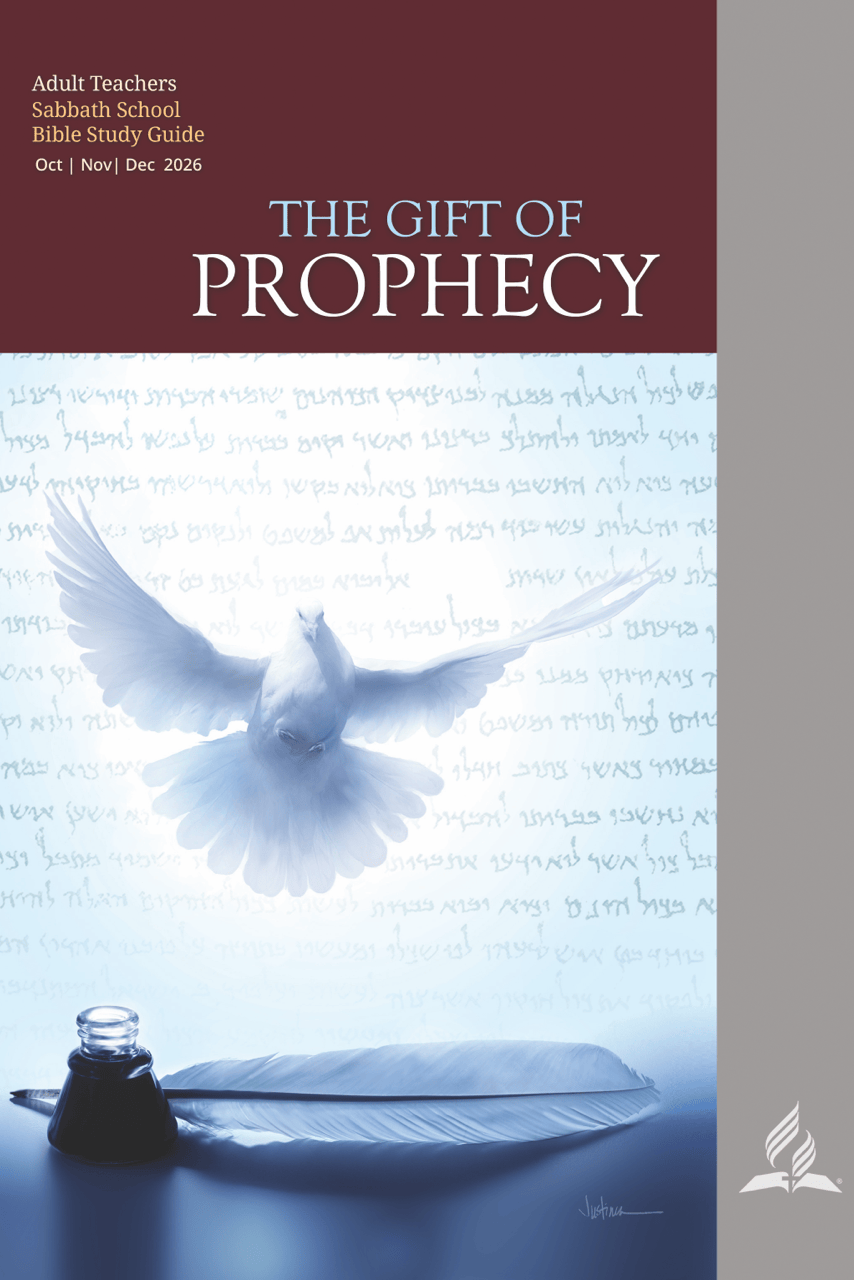
God is not silent — He has gone to extraordinary lengths across history to speak clearly to fallen humanity, and the Bible is the trustworthy record of that conversation.
Whoever you are
Whether or not you have ever opened a Bible, this lesson starts from a question everyone instinctively asks: Is there anyone out there, and do they care about us? This week's study argues that the Creator of the universe is not distant or silent, but has communicated persistently and creatively across thousands of years through nature, history, human voices, and written words. You don't need to be a theologian to find that idea worth exploring — the possibility that the deepest questions about suffering, meaning, and hope have been answered from outside ourselves is one of the most profound and relevant ideas any person can encounter.
The week, day by day
John, exiled and isolated on the rocky island of Patmos, became the recipient of the most visually rich prophetic book in the Bible — a reminder that God often meets us most powerfully in our most confined moments.
God speaks to us in two great 'languages': general revelation (the created world, which shouts of His power and care) and special revelation (Scripture and the prophets, which explain what nature alone cannot — why we suffer, and how we are saved).
Paul's declaration that 'all Scripture is God-breathed' () means the entire Bible carries divine origin and is profitable for shaping a whole, godly life — not just selected favourite passages.
Oral messages from God — whether at Sinai, at the Jordan, or on the Mount of Transfiguration — were just as inspired and reliable as written ones, because when God Himself speaks there is no room for miscommunication or distortion.
God commanded Moses to write things down immediately after Israel's victory over the Amalekites (), revealing that writing was His chosen technology for preserving truth across generations — giving permanence and precision to the spoken word.
God is a creative communicator: He used drama (Ezekiel lying on his side for hundreds of days), symbols (Daniel's great statue and beasts), and parables (Jesus' sower and seed) because some truths land deeper in the heart through image and story than through plain proposition.
Ellen G. White's own understanding of her gift was consistently humble: she believed she possessed the same quality of inspiration as biblical prophets yet never elevated her writings to the level of Scripture, always pointing people back to the Bible as the supreme authority.
In depth
The lesson opens with a profound and personal question: why would the Creator of the universe bother to speak to creatures like us? The answer the lesson gives is deeply moving — because we are lost, suffering, and dying, and God refuses to leave us without a word of hope. This is the heart of what theologians call 'revelation': God reaching across the divide to make Himself known. The lesson distinguishes between two channels of that reaching. 'General revelation' is what any person, anywhere, can observe — the staggering order of the cosmos, the intricate beauty of a leaf, the rhythm of the seasons. David saw it and broke into poetry. Paul argued that it leaves humanity without excuse. But general revelation, magnificent as it is, cannot tell you about salvation, about forgiveness, or about a Savior. That is why 'special revelation' — God speaking through prophets and supremely through Jesus Christ — was necessary. frames it beautifully: God spoke in many ways through the prophets, and then, as the fullest word of all, He spoke through His Son.
The lesson then takes us into the fascinating and sometimes misunderstood territory of how inspiration actually works. Second Timothy 3:16 is the classic text — 'all Scripture is God-breathed' — and adds that no prophecy came from human initiative; people 'spoke from God as they were carried along by the Holy Spirit.' The Greek word for 'carried along' (pheromenoi) is the same word used for a sailing ship driven by the wind — the sailors are real, the ship is real, the sails are real, but the driving power comes from outside them. This is a vivid picture of how Adventists (and most historic Protestants) understand inspiration: it is not mechanical dictation, as if the prophet were a typewriter, nor is it merely human genius, as if the Bible were just great religious literature. It is a genuine collaboration — divine initiative, human instrument.
The lesson moves carefully through the different modes God used to communicate. Sometimes He spoke in direct audible voice — at Sinai, at Jesus' baptism, to Moses face to face. This oral communication was just as authoritative as anything later written down. Then God, understanding how fragile human memory is and how messages distort over generations, commanded that these things be written. 'Write this as a memorial in a book,' He told Moses right after the defeat of the Amalekites (). Writing gives permanence, and permanence allows the message to travel through time. This is why we have a Bible at all — not because humans decided to preserve their religious impressions, but because God specifically commissioned a written record.
But words are not the only vehicle. The lesson's Thursday section reminds us that God is a master communicator who uses drama, symbol, and parable. The entire sacrificial system of the Old Testament was a living visual aid — a centuries-long acted prophecy pointing forward to the cross. When a worshiper laid their hand on a lamb's head, confessing sin, and watched the animal die, they were participating in a symbol that whispered of a coming Substitute. Daniel's terrifying statue of metals, his parade of beasts rising from the sea — these images were not obscure puzzles but vivid pictographic lessons about the rise and fall of empires and God's ultimate sovereignty. Jesus Himself was the supreme parable-teller: 'I am the Bread of Life,' 'I am the Light of the world,' 'I am the True Vine.' Each metaphor unpacks a different facet of who He is. The lesson invites us to appreciate that Scripture's rich variety of literary forms — poetry, prophecy, narrative, apocalyptic symbol, parable — is not a weakness but a strength, meeting human minds and hearts at multiple levels.
The lesson closes by bringing in Ellen G. White's own understanding of her prophetic gift. Adventists believe she met the biblical criteria for a genuine prophet, yet she herself was always careful to position her writings as subordinate to and pointing toward Scripture, never replacing it. She understood inspiration as a divine-human process: God gave the message, but the prophet clothed it in their own language, personality, and cultural context. This is why Bible prophets sound different from one another — Isaiah's soaring poetry versus Amos's blunt farmer's prose — and yet the central message is unified and coherent. Inspiration guarantees the trustworthiness of the message without erasing the messenger's humanity. For the thoughtful reader, this makes the Bible more remarkable, not less: that God could work through imperfect, culturally situated human beings and still produce a word that transforms lives across every century.
The Astronaut's Letter Home
This is something like what the Bible is. We are separated from our Creator by sin — a chasm every bit as vast as the void of space. And God, rather than leaving us in silence, has spoken. He used real human voices, real human personalities, real human languages — Isaiah's poetry, Luke's careful historian's prose, John's visionary fire — and through all of it, His own heart comes through. The words are theirs, but the love is His, and it crosses the chasm perfectly.
Other voices
Knight, a respected Adventist historian and theologian, has emphasized that understanding inspiration as a divine-human process — rather than mechanical dictation — actually deepens our confidence in Scripture, because it shows God willing to enter into genuine relationship with fallible human beings rather than bypassing them entirely.
Ellen White described the inspiration process as one in which God impresses the prophet's mind with ideas and truths, while the prophet then expresses those truths in their own words — which is why she always insisted that it is the thoughts, not necessarily the precise words, that are inspired, and why she pointed readers back to the Bible as the final authority.
Paulien, a leading Adventist New Testament scholar who has spent decades studying Revelation, notes that John's apocalyptic imagery is not random mysticism but is saturated with Old Testament allusions — meaning the visions given to John were themselves shaped by John's deep immersion in earlier Scripture, illustrating the collaborative, cumulative nature of biblical revelation.
Take it with you
Read Scripture as a personal letter from a God who is actively trying to reach you — not as a religious duty but as a response to a God who has gone to great lengths to communicate clearly.
When you encounter a difficult Bible passage expressed as symbol, drama, or parable, resist the urge to flatten it into a simple fact — sit with the image, because God chose that form deliberately to speak to your imagination and heart.
Let the two-volume library of God's communication — nature around you and Scripture in your hands — work together: nature raises the questions, and the Bible supplies the answers.
What is Sabbath School?
Sabbath School is part of Adventist worship, held before the main service each Saturday. Its purpose is simple: to read the Bible together and understand it better.
Each week has a topic, and the same lesson is studied worldwide. What makes it distinctive is how it is discussed — deliberately in small groups rather than one large gathering, so everyone present can take part. People share what they noticed, ask the questions they are actually carrying, and work through the passage together. Nobody is only listening.
The aim is not to arrive at a single answer but to send everyone away knowing the Bible a little better than they did that morning. You do not need to be Adventist to follow along, and you do not need to have read anything beforehand.
This overview was made to make the week’s Sabbath School reading clearer. It is based on the official Adult Bible Study Guide published by the General Conference of Seventh-day Adventists, and is meant to be read alongside the lesson, not in place of it.
The overview, its structure and its commentary were developed for the Christo Samuel Sabbath School app and this site. They are not to be copied, reproduced or republished elsewhere. If you spot an error, please let me know — I am always glad to correct it.
Lesson content © General Conference of Seventh-day Adventists · Adult Bible Study Guide. Overview and commentary © 2026 Christo Samuel.
The daily readings
The lesson itself, day by day, as published in the Adult Bible Study Guide. Tap any reference to read the passage.
Sab 24 Oct Revelation and Inspiration
Read for This Week’s Study , ; ; ; ; ; .
Memory Text: “The Revelation of Jesus Christ, which God gave Him to show His servants—things which must shortly take place. And He sent and signified it by His angel to His servant John, who bore witness to the word of God, and to the testimony of Jesus Christ, to all things he saw” (, , NKJV).
The apostle John had been part of the inner circle of the Twelve Apostles (; ; , ). After Christ’s ascension, he continued his ministry, in Jerusalem. Yet, before the fall of the city (A.D. 70), he moved to Ephesus in order to oversee churches in the Roman province of Asia Minor. During the Christian persecution under the Roman emperor Domitian, the apostle was exiled to Patmos, an island in the Aegean Sea.
On Patmos, John received special prophetic messages that were addressed not only to the seven churches of Asia Minor but also to Christians throughout the ages (, ). The prophetic message delivery chain, of which John was a part, looked something like this: God the Father, to Jesus Christ, to the angel, to the apostle John, and to the readers and hearers. This is a classic example of the revelation-inspiration process in which God uses prophets to communicate His messages to humanity.
This week’s lesson specifically examines the multiform revelation-inspiration process, with special focus on the oral, written, and dramatized ways the divine message has been communicated to human beings.
*Study this week’s lesson to prepare for Sabbath, October 31.
---
Selected Quotes from Ellen G. White
The word of God, like the character of its divine Author, presents mysteries that can never be fully comprehended by finite beings. The entrance of sin into the world, the incarnation of Christ, regeneration, the resurrection, and many other subjects presented in the Bible, are mysteries too deep for the human mind to explain, or even fully to comprehend. But we have no reason to doubt God’s word because we cannot understand the mysteries of His providence. In the natural world we are constantly surrounded with mysteries that we cannot fathom. The very humblest forms of life present a problem that the wisest of philosophers is powerless to explain. Everywhere are wonders beyond our ken. Should we then be surprised to find that in the spiritual world also there are mysteries that we cannot fathom? The difficulty lies solely in the weakness and narrowness of the human mind. God has given us in the Scriptures sufficient evidence of their divine character, and we are not to doubt His word because we cannot understand all the mysteries of His providence. The apostle Peter says that there are in Scripture “things hard to be understood, which they that are unlearned and unstable wrest. . . unto their own destruction.” . The difficulties of Scripture have been urged by skeptics as an argument against the Bible; but so far from this, they constitute a strong evidence of its divine inspiration. If it contained no account of God but that which we could easily comprehend; if His greatness and majesty could be grasped by finite minds, then the Bible would not bear the unmistakable credentials of divine authority. The very grandeur and mystery of the themes presented should inspire faith in it as the word of God. The Bible unfolds truth with a simplicity and a perfect adaptation to the needs and longings of the human heart, that has astonished and charmed the most highly cultivated minds, while it enables the humblest and uncultured to discern the way of salvation. And yet these simply stated truths lay hold upon subjects so elevated, so far-reaching, so infinitely beyond the power of human comprehension, that we can accept them only because God has declared them. Thus the plan of redemption is laid open to us, so that every soul may see the steps he is to take in repentance toward God and faith toward our Lord Jesus Christ, in order to be saved in God’s appointed way; yet beneath these truths, so easily understood, lie mysteries that are the hiding of His glory—mysteries that overpower the mind in its research, yet inspire the sincere seeker for truth with reverence and faith. The more he searches the Bible, the deeper is his conviction that it is the word of the living God, and human reason bows before the majesty of divine revelation.—Steps to Christ, pp. 106, 107.
Sun 25 Oct General and Special Revelation
Read , . Why is God so interested in speaking to us? What is He telling us through Jesus and the prophets?
What would the Creator of the cosmos have to say to us? Why does He communicate with us? It is because we are fallen human beings in a sinful world and face death, suffering, and trials; God, therefore, speaks to us because He wants us to know why we are here, why things are so bad, and why, despite it all, we can hope in His love for us.
God’s general revelation, as seen in the natural world, speaks eloquently of His infinite power and caring love. King David exclaimed, “The heavens declare the glory of God; and the firmament shows His handiwork” (, NKJV). The apostle Paul added, “For since the creation of the world His invisible attributes, that is, His eternal power and divine nature, have been clearly perceived, being understood by what has been made, so that they are without excuse” (, NASB).
It is also amazing to reflect on God’s restoring power manifested in the mysterious healing processes in our world. Indeed, “God’s healing power runs all through nature. If a tree is cut, if a human being is wounded or breaks a bone, nature begins at once to repair the injury. Even before the need exists, the healing agencies are in readiness; and as soon as a part is wounded, every energy is bent to the work of restoration.”—Ellen G. White, Education, p. 113.
As beautiful and instructive as the natural world can be, it reveals not only God’s power and love but also the presence of evil (see , ). This ambiguous message can be properly understood only in light of God’s special revelation—in both Jesus Christ, the incarnate Word of God, and in the Bible, the Written Word of God that testifies of Him ().
The Scriptures are the inspired record of God’s messages to all human beings throughout the ages. They tell us about the Creation of the world and its tragic fall, and about God’s amazing plan of redemption and the final restoration of planet Earth. As brief and selective as some biblical narratives can be, they are always reliable, because it’s God speaking to us (see ; ).
Though nature surely points to the reality of the Creator’s power and love, why do we still so desperately need the Written Word, as well? What does the Word tell us that nature, in and of itself, doesn’t?
---
Selected Quotes from Ellen G. White
To acknowledge that we cannot fully comprehend the great truths of the Bible is only to admit that the finite mind is inadequate to grasp the infinite; that man, with his limited, human knowledge, cannot understand the purposes of Omniscience. Because they cannot fathom all its mysteries, the skeptic and the infidel reject God’s word; and not all who profess to believe the Bible are free from danger on this point. The apostle says, “Take heed, brethren, lest there be in any of you an evil heart of unbelief, in departing from the living God.” . It is right to study closely the teachings of the Bible and to search into “the deep things of God” so far as they are revealed in Scripture. . While “the secret things belong unto the Lord our God,” “those things which are revealed belong unto us.” . But it is Satan’s work to pervert the investigative powers of the mind. A certain pride is mingled with the consideration of Bible truth, so that men feel impatient and defeated if they cannot explain every portion of Scripture to their satisfaction. It is too humiliating to them to acknowledge that they do not understand the inspired words. They are unwilling to wait patiently until God shall see fit to reveal the truth to them. They feel that their unaided human wisdom is sufficient to enable them to comprehend the Scripture, and failing to do this, they virtually deny its authority. It is true that many theories and doctrines popularly supposed to be derived from the Bible have no foundation in its teaching, and indeed are contrary to the whole tenor of inspiration. These things have been a cause of doubt and perplexity to many minds. They are not, however, chargeable to God’s word, but to man’s perversion of it. If it were possible for created beings to attain to a full understanding of God and His works, then, having reached this point, there would be for them no further discovery of truth, no growth in knowledge, no further development of mind or heart. God would no longer be supreme; and man, having reached the limit of knowledge and attainment, would cease to advance. Let us thank God that it is not so. God is infinite; in Him are “all the treasures of wisdom and knowledge.” . And to all eternity men may be ever searching, ever learning, and yet never exhaust the treasures of His wisdom, His goodness, and His power. God intends that even in this life the truths of His word shall be ever unfolding to His people. There is only one way in which this knowledge can be obtained. We can attain to an understanding of God’s word only through the illumination of that Spirit by which the word was given. “The things of God knoweth no man, but the Spirit of God;” “for the Spirit searcheth all things, yea, the deep things of God.” , . And the Saviour’s promise to His followers was, “When He, the Spirit of truth, is come, He will guide you into all truth. . . . For He shall receive of Mine, and shall show it unto you.” , . —Steps to Christ, pp. 108, 109.
Mon 26 Oct The Process of Inspiration
Many books and writings, not just the Bible, have come down to us through the ages. And yet, we deem the Bible as the Word of God. What separates it from other writings?
Read and . What important message should we take from these verses?
There is some discussion about the best translation of , but most Bible translations render this passage in a similar way, emphasizing that the whole Bible is of divine origin (, ).
One Bible commentator explains that “it seems more likely that Paul is contemplating scripture as a whole here and that he would say that the whole of scripture is ‘profitable for teaching, reproof, correction, and instruction in righteousness,’ than that every scripture passage is profitable in these ways.”—G. W. Knight III, The Pastoral Epistles: A Commentary on the Greek Text (Grand Rapids, MI: Eerdmans, 1992), p. 445.
But how should we understand the inspiration process that originated in the Bible? We should recognize that prophetic inspiration is the Holy Spirit assisting true prophets for the reliable communication of divine messages. That assistance is provided not only in the process of receiving the messages but also in communicating the messages clearly to their recipients.
God’s messages came through visions and dreams (; , ). God also used eyewitnesses (), Spirit-inspired historical research (), and divine impressions on the mind (). Regardless of the means used by the Holy Spirit, the prophets and biblical authors were given objective, rather than subjective, messages of truth to be shared. That is, God’s messages were not to be tampered with or in any way distorted by His messengers, even if they used their own words to express those messages.
The task of communicating prophetic messages to their original audiences could be done orally (), in written form (, ), or even through dramatization ().
Though many questions remain about how the Bible was inspired, or how inspiration works in general, why is it so important to trust the Bible as God’s inspired Word, regardless of what we may not fully understand about how it was written?
---
Selected Quotes from Ellen G. White
It is the first and highest duty of every rational being to learn from the Scriptures what is truth, and then to walk in the light and encourage others to follow his example. We should day by day study the Bible diligently, weighing every thought and comparing scripture with scripture. With divine help we are to form our opinions for ourselves as we are to answer for ourselves before God. The truths most plainly revealed in the Bible have been involved in doubt and darkness by learned men, who, with a pretense of great wisdom, teach that the Scriptures have a mystical, a secret, spiritual meaning not apparent in the language employed. These men are false teachers. It was to such a class that Jesus declared: “Ye know not the Scriptures, neither the power of God.” . The language of the Bible should be explained according to its obvious meaning, unless a symbol or figure is employed. Christ has given the promise: “If any man will do His will, he shall know of the doctrine.” . If men would but take the Bible as it reads, if there were no false teachers to mislead and confuse their minds, a work would be accomplished that would make angels glad and that would bring into the fold of Christ thousands upon thousands who are now wandering in error. We should exert all the powers of the mind in the study of the Scriptures and should task the understanding to comprehend, as far as mortals can, the deep things of God; yet we must not forget that the docility and submission of a child is the true spirit of the learner. Scriptural difficulties can never be mastered by the same methods that are employed in grappling with philosophical problems. We should not engage in the study of the Bible with that self-reliance with which so many enter the domains of science, but with a prayerful dependence upon God and a sincere desire to learn His will. We must come with a humble and teachable spirit to obtain knowledge from the great I AM. Otherwise, evil angels will so blind our minds and harden our hearts that we shall not be impressed by the truth. —The Great Controversy, pp. 598, 599.
Nature and revelation alike testify of God’s love. Our Father in heaven is the source of life, of wisdom, and of joy. Look at the wonderful and beautiful things of nature. Think of their marvelous adaptation to the needs and happiness, not only of man, but of all living creatures. The sunshine and the rain, that gladden and refresh the earth, the hills and seas and plains, all speak to us of the Creator’s love. It is God who supplies the daily needs of all His creatures. . . . “God is love” is written upon every opening bud, upon every spire of springing grass. The lovely birds making the air vocal with their happy songs, the delicately tinted flowers in their perfection perfuming the air, the lofty trees of the forest with their rich foliage of living green—all testify to the tender, fatherly care of our God and to His desire to make His children happy. The word of God reveals His character. He Himself has declared His infinite love and pity. When Moses prayed, “Show me Thy glory,” the Lord answered, “I will make all My goodness pass before thee.” , . This is His glory. The Lord passed before Moses, and proclaimed, “The Lord, The Lord God, merciful and gracious, long-suffering, and abundant in goodness and truth, keeping mercy for thousands, forgiving iniquity and transgression and sin.” , . He is “slow to anger, and of great kindness,” “because He delighteth in mercy.” ; .—Steps to Christ, pp. 9, 10.
Tue 27 Oct Oral Messages
Read . What assurance do we have that the oral messages delivered by God’s prophets were as inspired and reliable as the written ones?
God spoke to Adam and Eve before the Fall (, ) and after (). In both cases, they perfectly understood His words. His voice was heard in clear terms also at Sinai (), as well as at the baptism and the transfiguration of Jesus (, ). We might misinterpret when other people talk to us. But, surely, when God talks to anyone, there will be no miscommunication or deception.
The Bible affirms that “God spoke to Moses and said to him: ‘I am the Lord’ ” (, NKJV). Many Bible writers acknowledged hearing the voice of God as He spoke to them. This was the case, for example, with Isaiah (, ), Jeremiah (, , ), and Ezekiel (, ). Any attempt to deny these and other similar claims ends up questioning the honesty of the prophets and the reliability of the Bible itself.
As God spoke to the prophets in an intelligible human language, so did the prophets to their respective audiences. For instance, Noah was a true prophet of God and a faithful “preacher of righteousness” (). He did not write any portion of the Bible, but he delivered God’s message orally to his contemporaries, and his message was no less inspired than the writings of the canonical prophets.
Several other prophets, including Nathan, Elijah, Elisha, and John the Baptist, never wrote any portion of the Bible; instead, they delivered their message orally.
And what about Jesus Christ Himself? The Gospel record mentions that, during His earthly ministry, He “wrote on the ground with His finger” (, NKJV). That’s it. We have no record of Jesus’ writing anything else. But He taught and preached orally “as one having authority” (, NKJV). Some of His listeners even confessed, “No man ever spoke like this Man” (, , NKJV). Jesus was primarily an oral communicator of God’s messages. His messages were no less authoritative or binding simply because He Himself did not write any books of the Bible.
How fascinating that God has prophets who had no writings in the Bible. Why do these noncanonical prophets also carry authority?
---
Selected Quotes from Ellen G. White
Nathan fixed his eyes upon the king; then, lifting his right hand to heaven, he solemnly declared, “Thou art the man.” “Wherefore,” he continued, “hast thou despised the commandment of the Lord, to do evil in His sight?” The guilty may attempt, as David had done, to conceal their crime from men; they may seek to bury the evil deed forever from human sight or knowledge; but “all things are naked and opened unto the eyes of Him with whom we have to do.” . “There is nothing covered, that shall not be revealed; and hid, that shall not be known.” . Nathan declared: “Thus saith the Lord God of Israel, I anointed thee king over Israel, and I delivered thee out of the hand of Saul. . . . Wherefore hast thou despised the commandment of the Lord, to do evil in His sight? thou hast killed Uriah the Hittite with the sword, and hast taken his wife to be thy wife, and hast slain him with the sword of the children of Ammon. Now therefore the sword shall never depart from thine house. . . . Behold, I will raise up evil against thee out of thine own house, and I will take thy wives before thine eyes, and give them unto thy neighbor. . . . For thou didst it secretly; but I will do this thing before all Israel, and before the sun.” The prophet’s rebuke touched the heart of David; conscience was aroused; his guilt appeared in all its enormity. His soul was bowed in penitence before God. With trembling lips he said, “I have sinned against the Lord.” All wrong done to others reaches back from the injured one to God. David had committed a grievous sin, toward both Uriah and Bathsheba, and he keenly felt this. But infinitely greater was his sin against God. . . . Very many, reading the history of David’s fall, have inquired, “Why has this record been made public? Why did God see fit to throw open to the world this dark passage in the life of one so highly honored of Heaven?” The prophet, in his reproof to David, had declared concerning his sin, “By this deed thou hast given great occasion to the enemies of the Lord to blaspheme.” Through successive generations infidels have pointed to the character of David, bearing this dark stain, and have exclaimed in triumph and derision, “This is the man after God’s own heart!” Thus a reproach has been brought upon religion, God and His word have been blasphemed, souls have been hardened in unbelief, and many, under a cloak of piety, have become bold in sin. But the history of David furnishes no countenance to sin. It was when he was walking in the counsel of God that he was called a man after God’s own heart. When he sinned, this ceased to be true of him until by repentance he had returned to the Lord. The word of God plainly declares, “The thing that David had done was evil in the eyes of the Lord.” , margin. And the Lord said to David by the prophet, “Wherefore hast thou despised the commandment of the Lord, to do evil in His sight? . . . Now therefore the sword shall never depart from thine house; because thou hast despised Me.” Though David repented of his sin and was forgiven and accepted by the Lord, he reaped the baleful harvest of the seed he himself had sown. The judgments upon him and upon his house testify to God’s abhorrence of the sin. . . . David’s repentance was sincere and deep. There was no effort to palliate his crime. No desire to escape the judgments threatened, inspired his prayer. But he saw the enormity of his transgression against God; he saw the defilement of his soul; he loathed his sin. It was not for pardon only that he prayed, but for purity of heart. David did not in despair give over the struggle. In the promises of God to repentant sinners he saw the evidence of his pardon and acceptance.—Patriarchs and Prophets, pp. 721–723, 725.
Wed 28 Oct Written Messages
Some famous speeches have deeply impacted people’s lives and even changed the course of history. If these speeches were not recorded, the words would have faded or become distorted with the passage of time. Thus, writing gives permanence to the spoken word, and that permanence allows the message to be transmitted through time.
Shortly after the Israelites left Egypt and defeated the Amalekites, God instructed Moses to “write this for a memorial in the book” (, NKJV). Beginning with Moses, who authored the first five books of the Bible, Psalm 90, and Job, the Holy Spirit guided the canonical prophets to produce the writings that now comprise the 66 books of the Bible.
Read ; , ; ; and . What are some of the reasons God asked His prophets to write down the messages that He gave them?
The various books of the Bible reflect the literary style and skills of their respective writers. As we will discuss in next week’s study, the personal nuances and various styles of each author don’t take away from their messages, because there are no “degrees” of inspiration. Some parts of the Bible are obviously more relevant and applicable to our lives and faith today than are other parts. But this truth doesn’t make one part of the Bible more inspired than another part.
Sometimes Bible writers recorded the inspired messages that they first delivered orally, by themselves, or by a trusted associate. In the book of Deuteronomy, Moses recorded the last speeches that he made to the Israelites before his death. The four Gospels register many of the sermons and teachings of Jesus during His earthly ministry.
But there are instances in which prophets quoted non-inspired sources (, , ) and even the words of Satan (, ).
We should remember that as the prophets recorded the feelings and desires of other people, they also expressed their own human reactions (see ; , ). Furthermore, the Bible describes many good examples to be imitated but also many bad ones to be avoided ().
While reading the Bible, we should keep in mind that, while not written in perfect language, it carries an infallible message that will stand the test of time.
---
Selected Quotes from Ellen G. White
The lives recorded in the Bible are authentic histories of actual individuals. From Adam down through successive generations to the times of the apostles we have a plain, unvarnished account of what actually occurred and the genuine experience of real characters. It is a subject of wonder to many that inspired history should narrate in the lives of good men facts that tarnish their moral characters. . . . The inspired writers did not testify to falsehoods to prevent the pages of sacred history being clouded by the record of human frailties and faults. . . . It is one of the best evidences of the authenticity of the Scriptures that the truth is not glossed over nor the sins of its chief characters suppressed. . . . How many biographies have been written of faultless Christians, who, in their ordinary home life and church relations, shone as examples of immaculate piety. . . . Yet had the pen of inspiration written their histories, how different would they have appeared. There would have been revealed human weaknesses, struggles with selfishness, bigotry, and pride, hidden sins, perhaps, and the continual warfare between the spirit and the flesh. . . . Had our good Bible been written by uninspired persons, it would have presented quite a different appearance and would have been a discouraging study to erring mortals, who are contending with natural frailties and the temptations of a wily foe. But as it is, we have a correct record of the religious experience of marked characters in Bible history. Men whom God favored, and to whom He entrusted great responsibilities, were sometimes overcome by temptation and committed sins, even as we of the present day strive, waver, and frequently fall into error. But it is encouraging to desponding hearts to know that through God’s grace they could gain fresh vigor to again rise above their evil natures; and, remembering this, we are ready to renew the conflict ourselves.—Conflict and Courage, p. 7.
The murmurings of ancient Israel and their rebellious discontent, as well as the mighty miracles wrought in their favor and the punishment of their idolatry and ingratitude, are recorded for our benefit. The example of ancient Israel is given as a warning to the people of God, that they may avoid unbelief and escape His wrath. If the iniquities of the Hebrews had been omitted from the Sacred Record, and only their virtues recounted, their history would fail to teach us the lesson that it does. . . . God is as powerful to save from sin today as He was in the times of the patriarchs, of David, and of the prophets and apostles. The multitude of cases recorded in sacred history where God has delivered His people from their own iniquities should make the Christian of this time eager to receive divine instruction and zealous to perfect a character that will bear the close inspection of the judgment.—Conflict and Courage, p. 8.
Thu 29 Oct Drama, Symbols, Parables
The Bible has a rich variety of word pictures and metaphors. For example, the whole Old Testament sacrificial system of patriarchal altars, the Mosaic tabernacle, and the temple in Jerusalem was a pictographic representation of Christ’s atoning sacrifice on the cross and His heavenly priesthood ().
In the prophecies of Daniel, the kingdoms and powers in the world were represented by the different parts of a great image (), various animals and horns (Daniel 7 and 8), and two kings (Daniel 11). Similar representations appear also in the book of Revelation, as in the case of the two beasts of chapter 13.
In His teachings, Jesus spoke of Himself, for instance, as the Bread of Life (, ), the Light of the world (, ), and the True Vine (). And through the parable of the sower (, ) and several other ones (, etc.), Jesus illustrated the nature and growth of His kingdom.
Read . Why do you think God not only spoke verbally but also dramatized some of His messages?
A vivid dramatization appears in , where God asked the prophet to make a miniature model of Jerusalem and to lay himself down, first on his left side for 390 days, representing the house of Israel, and then on his right side for 40 days, representing the house of Judah. Another visual experience was Hosea’s divinely ordained marriage to Gomer, a prostitute, representing Israel’s spiritual unfaithfulness to God ().
The dramatic experiences of Ezekiel and Hosea seem quite shocking today. But that was the point: they were supposed to be shocking, not just to us but also to the people back then. At a time when the warnings of the prophets were openly rejected (see ), the last act of divine mercy was to dramatically alert the people to their true condition in order to lead them to genuine repentance. Such a dramatic presentation certainly should have shown them how seriously they should have taken God’s warning to them.
What kind of dramatization might someone do today to warn us about, say, being Laodicean? (See .)
---
Selected Quotes from Ellen G. White
The great Teacher proclaimed the truth to humanity, many of whom could not be educated in the schools of the rabbis, neither in Greek philosophy. Jesus uttered truth in a plain, direct manner, giving vital force and impressiveness to all His utterances. . . . The rabbis and teachers had virtually shut up the kingdom of heaven from the poor and the afflicted, and left them to perish. In His discourses Christ did not bring many things before them at once, lest He might confuse their minds. He made every point clear and distinct. . . . Christ was the originator of all the ancient gems of truth. Through the work of the enemy these truths had been displaced. They had been disconnected from their true position and placed in the framework of error. Christ’s work was to readjust and establish the precious gems in the framework of truth. The principles of truth that had been given by Himself to bless the world had, through Satan’s agency, been buried and had apparently become extinct. Christ rescued them from the rubbish of error, gave them a new, vital force, and commanded them to shine as precious jewels and stand fast forever. Christ Himself could use any of these old truths without borrowing the smallest particle, for He had originated them all. . . . As Christ presented these truths to minds, He broke up their accustomed train of thought as little as possible. . . . He therefore aroused their minds by presenting truth through the agency of their most familiar associations. He used illustrations in His teaching that called into activity their most hallowed recollections and sympathies, that He might reach the inner temple of the soul. Identifying Himself with their interests, He drew His illustrations from the great book of nature, using objects with which they were familiar. The lily of the field, the seed sown by the sower, the springing up of the seed, and the harvesting of the grain, the birds of the air—all these figures He used to present divine truth, for these would remind them of His lessons whenever they should afterward look upon them. . . . Although Satan has misrepresented God’s purposes, falsified His character, and caused people to look upon God in a false light, yet through the ages God’s love for His earthly children has never ceased. Christ’s work was to reveal the Father as merciful, compassionate, full of goodness and truth.... The only begotten Son of God sweeps back the hellish shadow in which Satan has enveloped the Father, and declares, “I and My Father are one; look on Me and behold God.”—Christ Triumphant, p. 225.
Fri 30 Oct Ellen G. White on Revelation and Inspiration
Seventh-day Adventists believe that Ellen G. White was divinely inspired. Her writings, life, and ministry meet the criteria of a true prophet. She possessed the same quality of inspiration as Bible prophets, though she never considered her writings to be the same as Scripture. On the contrary, Ellen G. White always uplifted the Bible. But how did she herself understand God’s prophetic revelations to her and the process of her inspiration?
First, Ellen G. White always considered the Bible as the authoritative and infallible revelation of God. The Bible reveals God’s truth and His plan of salvation for the fallen human race. In that process, as we are learning, He uses prophets to communicate His messages.
Second, Ellen G. White recognized that the process of inspiration involved divine-human interaction. God communicated His messages, but then the prophet would convey the divine instruction using his or her own words. As Ellen G. White put it: “It is not the words of the Bible that are inspired, but the men that were inspired. Inspiration acts not on the man’s words or his expressions but on the man himself, who, under the influence of the Holy Ghost, is imbued with thoughts. . . . The divine mind and will is combined with the human mind and will; thus the utterances of the man are the word of God.”—Selected Messages, book 1, p. 21.
In relation to visions and prophetic dreams, Ellen G. White understood “thought inspiration” as a union of divine revelation and human experience. She wrote, “ ‘The Bible, with its God-given truths expressed in the language of men, presents a union of the divine and the human.’ ”—Selected Messages, book 1, p. 25. God used many ways to produce an understanding of His message in the mind of His messenger. These included picture representations, words, and thoughts that engaged all the prophet’s senses. Ellen G. White’s experience was similar to that of Bible writers.
Third, Ellen G. White noted that not all of her human experiences and communications were inspired. “There are times when common things must be stated,” she advised, “common thoughts must occupy the mind, common letters must be written and information given that has passed from one to another of the workers. Such words, such information, are not given under the special inspiration of the Spirit of God.”—Selected Messages, book 1, p. 39. It is important to realize this distinction as we read and relate to her writings and experiences, particularly her correspondence and diaries.
Knowing Ellen G. White’s understanding of revelation and inspiration helps us avoid extremes and read her counsels prudently with understanding.
Click here for Further Study 🔗.
---
Selected Quotes from Ellen G. White
This Day With God, “Let Christ Guide,” December 18, p. 361. The Upward Look, “Nature’s Lesson Book,” June 2, p. 167.
Lesson content © General Conference of Seventh-day Adventists · Adult Bible Study Guide.
Carry it with you
Everything here, plus the parts that only work when they are yours.
- Highlight and save any verse
- Write your own notes on every chapter
- Search by how you feel, not just by word
- A daily reading that keeps your place
Get the app
Free on both stores. Pick yours.